


Emily Brontë’s work often expresses a belief in the continuance of souls after death, which is unfortunate because that means her own soul would have had to witness the absurdity that is Emerald Fennell’s Wuthering Heights, released in theaters on Valentine’s Eve. Book purists need not bother enumerating the differences between Brontë’s classic novel and this film, which stylizes its title in quotation marks—that time would be better spent actually reading, or rereading, said novel.
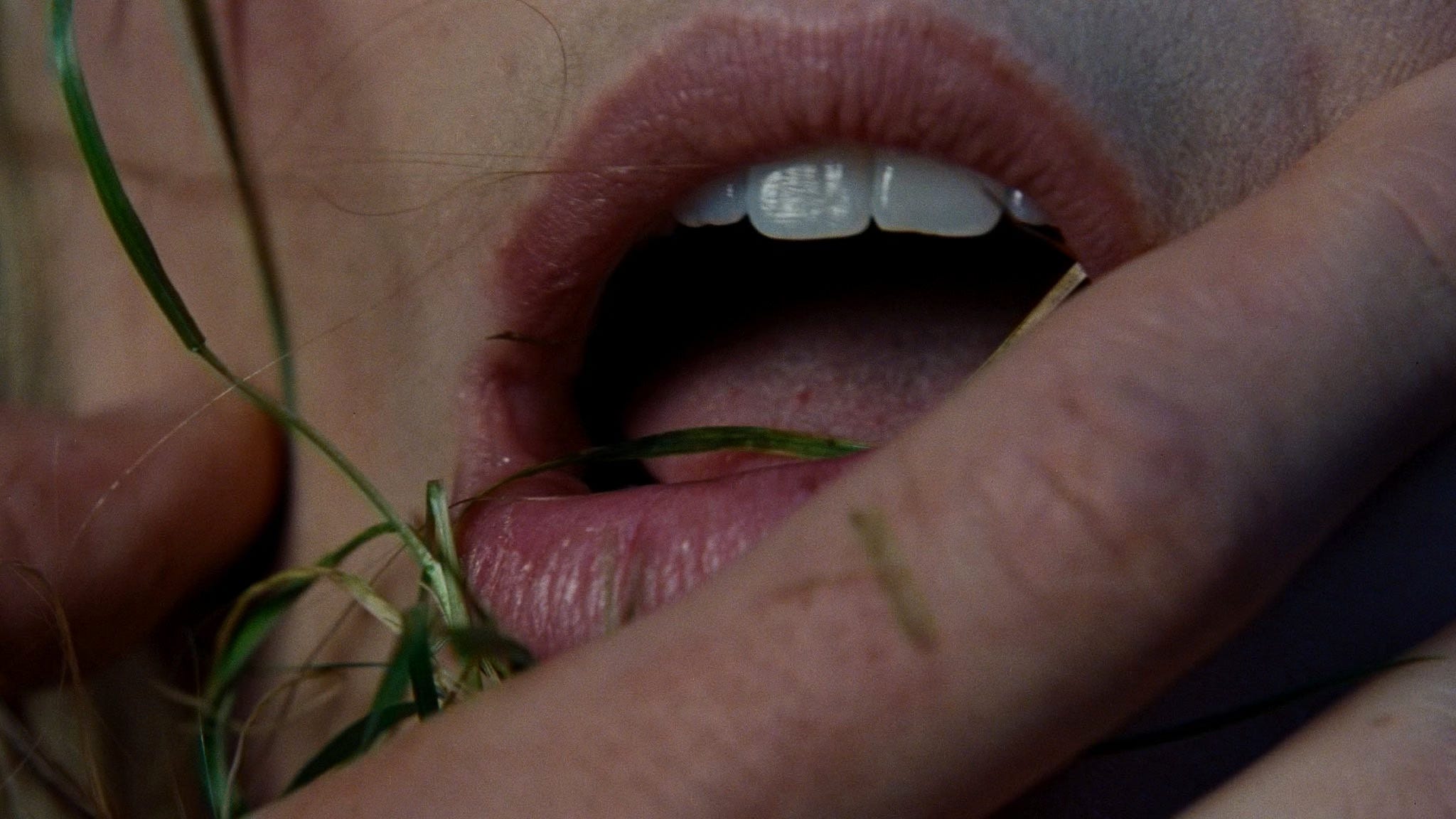
It is not that films should not take creative liberties with their source material or attempt reimagining well-known, much-loved tales. Many films have done it well, and meaningfully. But half the time I was watching “Wuthering Heights,” I felt like laughing, and half the time, I felt disgusted. There was nothing sexy about the squelching egg yolks, the dirty, grassy mouths, poor Isabella barking like a dog.1 “To be a whacher is not a choice. / There is nowhere to get away from it,” I remembered from Anne Carson’s “The Glass Essay” as I tried to look anywhere but the screen. I felt clowned, baited, like an “abject reptile”—and that, too, on my wedding anniversary.2
Anachronism can work, and heavy stylization can work. Muddles, however, are simply muddles. In Baz Luhrmann’s Romeo + Juliet, Shakespeare’s 14th-century Verona is transposed to 1990s “Verona Beach,” where the Montagues and Capulets are imagined as two rival gangs. But it respects its source material, doesn’t shit all over it. The result is a weird, brilliant, operatic cohesion between its Shakespearean dialogue and its campy setting.
Here, however, grimy, realistic 19th-century visuals clash with red vinyl, Euphoria face gems, 1940s victory rolls, and enough aspic to put me off Jell-O for a lifetime. Margot Robbie is Oktoberfest Barbie, while Jacob Elordi is Wanderer Above the Sea of Fog. Are we in a comedy or a tragedy? Shakespeare himself knew how to blend the best of both, but here the tonal incoherence strikes a clanging discord, exemplified by the opening scene where a hanged man gets an erection while a crowd jeers and engages in sundry bawdry—icky but cartoonish, adding nothing to the story.
Speaking of Elordi, despite being yet another white Heathcliff, he does justice to the role, sincerely delivering the few lines of Brontë’s novel that are kept in when he mourns the dead Cathy. Margot Robbie, however, is entirely too modern, visibly acts, and remains bathetic even when she tries to go for pathos. They seem to be in two different movies, or perhaps Elordi is simply the straight man to Robbie’s funny woman—Heathcliff and Cathy reimagined as a comedic duo for the 21st century.
Some things, yes, I genuinely liked about the film: the cinematography, parts of the soundtrack, the fact that I never felt bored during its 136 minutes. The dollhouse in Thrushcross Grange was genius for bringing to screen a writer whose work frequently features jails, prisons, captives, chains. Yet our sad little pornbrained era can only see these as a code for BDSM, and not even a particularly scintillating BDSM but a BDSM that grotesquely conflates abuse and entrapment with kink and bondage, a BDSM we can only giggle at like virgins or wear as an edgy costume, afraid to own our desires. I’d been hoping for something along the lines of In the Realm of the Senses, but all I got were eggs smashed under bedclothes instead of up vaginas.
Really, there is no doubt about the creativity and craftsmanship and hours of labor and attention to detail that went into the elaborate costumes and sets.3 But I couldn’t help but feel that Cathy and Heathcliff were ruining my appreciation of them by how irritating they were in their 30-year-olds-do-teenagers rendering of what was sold to us as “the greatest love story ever told.” I don’t care for your pretend hysterics! Get out of the way, I just want to soak up the skin walls! I was tempted to shout, much as the philosopher Diogenes told Alexander the Great he was blocking his view of the sun.
The main thing that confounds me is that in the 131 years since the Lumière brothers first invented the cinematograph, no one has made a really good adaptation of Wuthering Heights, and yet it is a novel that should not be that difficult to adapt. It is not some modernist puzzle like Ulysses. Aside from a little trickiness in the framing device of the two narrators and one leap backwards in time at the beginning, it proceeds pretty linearly. The events are straightforward, the characters vividly painted, the dialogue memorable. It was actually very strange that the director of Promising Young Woman, a movie about rape, trauma, and revenge, would get so much wrong about a story with such similar themes.
At least the film reinforced my love for my husband by reminding me of the time he mistakenly referred to Wuthering Heights as “Suffering Hill.” Emerald Fennell’s “Wuthering Heights,” clearly a ragebait parody of the Brontë novel (for what other explanation is possible?) should have been titled Suffering Hill. Hollywood no longer really cares about making films that simply give us a good story well told. Buoyed up on great flares of marketing, films float for a few seconds, then crumple and deflate. The point is to get our backsides into movie theater seats, not make our sitting there worthwhile. If we are baited into raging about these bad movies online, thereby getting more backsides into theater seats, all the better.
When Emily Brontë was bitten by a dog as a teenager, she walked into the kitchen, took a red-hot poker from the fire, and calmly cauterized the wound. When her brother Branwell accidentally lit his room on fire while drunk, Emily matter-of-factly dragged him from his bed and doused the flames with a pan of water. Who will cauterize the wound in our culture, drag us bodily from the burning bed? Films are delivering us visual feasts with little to no nutritional value. Eventually we will refuse such fodder and, like Cathy and Heathcliff themselves, prefer starvation. “What meat is it, Emily, we need?”
—
This review is kind of an epilogue to an earlier essay about the book and why its second half—pretty much universally excluded from film adaptations—is so important. You can read that here:
Stop adapting only half of Wuthering Heights.

Catherine Linton (née Earnshaw) dies on page 121 of my edition of Wuthering Heights, but the book goes on for another 127 pages. What, in those 127 pages, do you suppose happens? If you’re Hollywood, your answer would be “nothing.” Nothing happens in those 127 pages. Maybe Heathcliff mopes around a …

Dear readers, I am all wuthered out, so in terms of posts this is probably the last you will be hearing from me about Wuthering Heights for a while. If you’ve seen the movie and agree or disagree with me, if you love Emily Brontë, or if you just want to say hi, please leave a comment—I always love hearing from you!
In the book she is an idealistic young woman who finds out, unfortunately, that the sexy “bad boy” she has married is really an abusive, deeply messed up man hell-bent on vengeance, is rejected by her brother, and—very bravely, I think, especially for that era—finally runs away from her husband to raise her child alone.
Valentine’s Day, for those curious. “Abject reptile” is an insult used by the second Catherine in the second half of the book.
For all its garishness, there is actually a sort of kinship between the Thrushcross Grange set used in the film and Heathcliff’s description, “...we saw—ah! it was beautiful—a splendid place carpeted with crimson, and crimson-covered chairs and tables, and a pure white ceiling bordered by gold, a shower of glass drops hanging in silver chains from the centre, and shimmering with little soft tapers.”
This was such a sharp, incisive review. I really enjoyed it! I really appreciated how you articulated the difference between creative reinterpretation and tonal incoherence since that distinction is rarely made so clearly. I haven't watched the movie, but the trailer and the reviews online say enough about it. I feel your frustration in this and to be frank "WHAT HAVE THEY DONE WITH THE BOOK?" And the last metaphor on cauterizing the cultural wound is chef's kiss. I absolutely love your insights and commentaries and am back on track on reading all your works.
Great critique, Ramya! I would mention the glorious “West Side Story” (both stage play and film) as a perfect example of how far you can stretch a new production and still remain faithful to the core intent of the source material (Romeo & Juliet).