

Stop adapting only half of Wuthering Heights.
Why the second generation matters

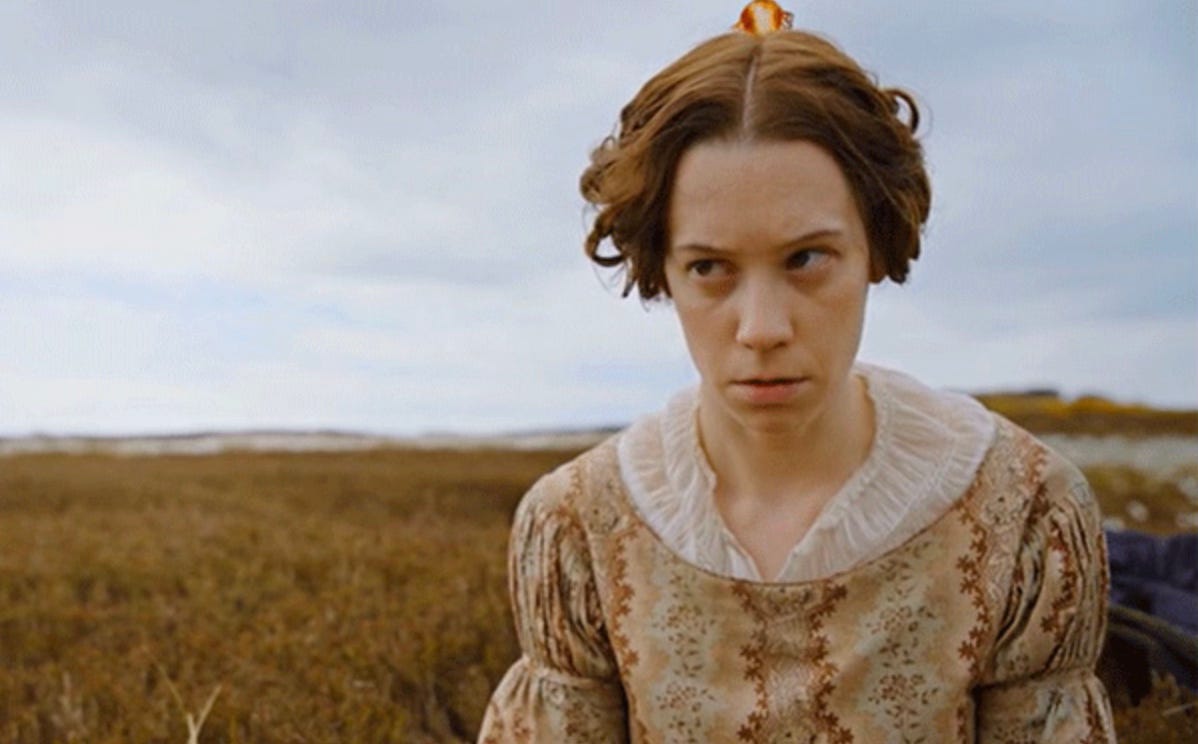
Catherine Linton (née Earnshaw) dies on page 121 of my edition of Wuthering Heights, but the book goes on for another 127 pages. What, in those 127 pages, do you suppose happens? If you’re Hollywood, your answer would be “nothing.” Nothing happens in those 127 pages. Maybe Heathcliff mopes around a lot moaning and wailing after “the ghost of his heart’s darling.” And maybe said ghost glides around the moors, hither and thither, intoning Kate Bush’s 1978 hit while she waits for Heathcliff to finally kick the bucket and join her. Whatever it is that happens in the second half of Emily Brontë’s novel, it is not important. Brontë, silly girl, wasted her time.
From the 1939 adaptation of Wuthering Heights onward, Hollywood has been loath to touch the second generation of the novel’s characters. Critics, too, for a long time, were willing to dispense with it. “Great as the novel is,” wrote E. M. Forster in 1927, “one cannot afterwards remember anything in it but Heathcliffe [sic] and the elder Catherine.” This is a pity, because to dismiss the second generation is to diminish the fullness of Brontë’s vision. Take the novel’s second half away, and Wuthering Heights narrows to an obsessive love story, a passionate, savage romance, a yarn of yearning and longing, illicit embraces on the Yorkshire moors, unrequited desire amongst the cliffs and heather. It is a serious misreading.
Misreading is something Brontë warns us about right from the start. Lockwood, our narrator, arrives in this wild landscape from the city and, humorously, misreads much. He mistakes Heathcliff for a fellow “misanthropist” and “[a] capital fellow!” He mistakes “an obscure cushion” to be full of cats, only to see “[u]nluckily, it was a heap of dead rabbits.” He mistakes Cathy II to be first Heathcliff’s wife, then Hareton’s, only to find out she is the widow of Heathcliff’s recently deceased son Linton.
So readers, coming to Wuthering Heights for the first time, might imagine themselves in a sort of torrid, northern English, 19th-century pulp romance, only to discover Wuthering Heights is a multigenerational saga, set mostly during the last three decades of the 18th century, that lays out the workings of cruelty, obsession, abuse, selfishness, revenge, and uncontrolled passion, and shows their eventual remolding into kindness, maturity, and healthy love. And the couple we should be rooting for is not Heathcliff and the elder Catherine but Hareton and the younger Catherine.
Lockwood comes to the Heights because he has rented a nearby property, Thrushcross Grange, for a year, and Heathcliff, who lives at the Heights, is his landlord. A snowstorm causes him to stay the night, and he is taken to a bedroom that was once the elder Catherine’s, on whose window ledge he finds scratched, over and over again, the names “Catherine Earnshaw,” “Catherine Heathcliff,” and “Catherine Linton.” Read them forwards, and they trace the journey of the first Catherine; backwards, and they trace the journey of the second Catherine. But to hear it all, Lockwood will have to go back to Thrushcross Grange and seek the story from the housekeeper, Nelly Dean.
Nelly Dean sits down with a bit of sewing and starts to stitch together this convoluted tale of Earnshaws, Heathcliffs, and Lintons. It begins some thirty years in the past, when the occupants of the Heights were Mr. and Mrs. Earnshaw, their 14-year-old son Hindley, their almost 6-year-old daughter Catherine, and the servants, including Nelly, who is Hindley’s age, and an irascible old brimstone-and-hellfire Bible-thumper named Joseph. One day, in fairytale fashion, Mr. Earnshaw goes to Liverpool on business, promising to bring back a violin for Hindley, a horsewhip for Cathy, and some fruit for Nelly. Three days later, he returns, opens the bundle of his coat, and reveals “a dirty, ragged, black-haired child” who can only stare and speak unintelligible gobbledygook. Mr. Earnshaw explains that he had seen the child “starving, and houseless” in the streets, failed to discover the child’s origins or parentage, and took him home.
Mrs. Earnshaw does not take so kindly to the boy. She is more inclined to side with her husband’s latter statement that the child is “dark as if it came from the devil” than obey his former injunction to “take it as a gift of God.” She is even “ready to fling it out of doors,” upbraiding her husband for “bring[ing] that gipsy brat into the house, when they had their own bairns to feed, and fend for.” For their part, the bairns are not seriously affected by their father’s strange rescue-kidnapping, choosing to let the adults sort it out, until they go to look for their presents. The violin is “crushed to morsels,” and the whip is lost. It is then that Hindley “blubber[s] aloud” and Cathy “grin[s] and spit[s]” at the child. Neither of them want “it” (at this point the child is referred to by everyone, even Mr. Earnshaw, as “it”) in their beds; Nelly leaves the boy “on the landing of the stairs, hoping it might be gone on the morrow,” is banished by Mr. Earnshaw, and comes back to learn that the child has been named “Heathcliff,” after a son who’d died in childhood.
In her absence, there has been a rearrangement of attachments and affections. Cathy and Heathcliff are now “very thick” friends, but Hindley—and Nelly herself—“hated him.” What about the Earnshaw parents? Mrs. Earnshaw is firmly in the camp of Heathcliff haters, failing to intervene when Hindley and Nelly give Heathcliff “blows” and “pinches.” Mr. Earnshaw, on the other hand, is “furious” upon “discover[ing] his son persecuting the poor, fatherless child.” When I first read Wuthering Heights, I saw Mr. Earnshaw as a kind-hearted man who dies too soon and Hindley as nothing more complicated than a mean teen who grows into an even meaner adult. But Mr. Earnshaw, for all his empathy and well-intentioned desire to protect his foundling, really, I think, pulls the lever that sets all the cogs and gears of the tragedy rolling.
Brontë does not linger on the relationship the children have with Mr. Earnshaw, so we might gloss over it, but the details she does give are telling. Mr. Earnshaw “took to Heathcliff strangely” and favors him above his own biological children.1 We don’t know why; at any rate, a parent who plays favorites is bound to sow evil in the home. If Mr. Earnshaw had come home with fiddle in tact, rather than smashed in the act of bringing “a cuckoo” (as Nelly calls Heathcliff) into the nest, perhaps things might have been okay. But the broken fiddle becomes a cipher for lost paternal love, and unlike Cathy, Hindley, because of the age difference, cannot bond with Heathcliff as playmate. Worse, he loses his only allies when Mrs. Earnshaw dies and Nelly defects to the camp of Heathcliff sympathizers. The result is that Hindley “had learned to regard his father as an oppressor rather than a friend, and Heathcliff as a usurper of his parent’s affections and his privileges, and he grew bitter with brooding over these injuries.” Jealousy begets violence, violence becomes Heathcliff’s leverage for soliciting even more fatherly fondness, and this fondness provokes further resentment towards the usurper.
Mr. Earnshaw worsens in health and as a parent. He becomes “grievously irritable,” and “suspected slights of his authority nearly threw him into fits,” especially where it concerns his partiality to Heathcliff. He threatens Hindley with physical punishment, and Hindley does not escape to college without first eliciting the warm paternal remark that “Hindley was naught, and would never thrive as where he wandered.” Joseph, that miserable, sermonizing sycophant, encourages Mr. Earnshaw to treat his children all the more severely, a disaster waiting to happen when combined with Cathy’s mischievous nature. As with Hindley, Mr. Earnshaw wounds her with his words: “I cannot love thee; thou’rt worse than thy brother…. I doubt thy mother and I must rue that we ever reared thee!” The effect of such statements is to first draw tears from, then harden Cathy. One night Mr. Earnshaw asks her, “Why canst thou not always be a good lass, Cathy?” She replies, “Why cannot you always be a good man, father?” The implication is that the daughter’s badness stems from the father’s badness—the sins of the father are visited upon the child. Parents may scold and reprimand and moralize and chide, but unless they look at their own bad behavior, they will be unlikely likely to find the cause—at least the partial cause—of what they condemn in their offspring.
One cannot wonder at the way these children turn out after so many years of abuse, grief, emotional neglect, and, for Heathcliff, racism. We see that physical abuse is a normal thing for the children at the Heights, for the first “sound blow” is delivered by Mr. Earnshaw when he sees Cathy “grinning and spitting” at the stranger. Later, he froths with rage that he cannot strike Hindley with his stick when Hindley ill treats Heathcliff. We may think that Cathy and Hindley deserve it, but there are other ways to “teach [a child] cleaner manners.” What these children are taught instead is that it is perfectly acceptable to hit, slap, pinch, and beat. Even in play, Cathy enjoys “slapping and ordering” others. Like their father, the Earnshaw children have passionate, easily provoked natures, and the nurture of these loveless years makes them selfish, hard, unable to mature.
As for Heathcliff, we know little about his early years, but his reaction to physical violence is significant. What responses can one can have to being bullied? One can break down and start crying, turning against oneself. One can turn against the aggressor, fighting back, returning blow for blow. Or one can simply not react, denying the bully satisfaction in eliciting tears or blows. Heathcliff’s responses are always the third, and Nelly theorizes that he must have been “hardened, perhaps, to ill-treatment” before he came to the Heights. His other emotional reactions, too, are muted: when he gets sick, he is “uncomplaining as a lamb”; when Hindley throws an iron weight at him, then knocks him under a horse’s feet, Heathcliff “cooly” sits down for a few minutes to recover; in response to Mr. Earnshaw’s partiality, he expresses neither gratitude nor insolence but merely indifference.
It is only with Cathy that he feels safe allowing himself fuller emotional expression, as is evident when Mr. Earnshaw dies. Both of them “set up a heart-breaking cry,” then later calm and soothe one another. After Hindley returns as the head of the house and resumes his abuse—to both Cathy and Heathcliff, especially Heathcliff, exiling him from the house to the servants’ quarters, stripping him of education, and condemning him to hard labor—Cathy and Heathcliff, “the unfriended creatures,” cling close to one another. Their chief delight is their rambles together on the moors. Outside, in nature, with only each other, they are free.
There is nothing to disturb this closeness until Cathy and Heathcliff end up at Thrushcross Grange, where a dog bites Cathy on the ankle as she and Heathcliff are spying on the Linton children, Edgar and Isabella, and Cathy is taken inside the Grange for five weeks to recover. This is where we first see a division between Wuthering Heights and Thrushcross Grange, and Brontë clearly means to contrast them. Poor Heathcliff! With what envy and admiration does he look upon the crimson luxuriance (“ah! it was beautiful”), so different from the savage gargoyles and cold flagstones of the Heights! The Grange is the best house in the neighborhood, the Heights only second best. The Grange lies low in a valley, “buried in trees,” while the Heights are subject to the “[p]ure, bracing ventilation” of the “north wind, blowing over the edge.” The Heights are nature, wildness, isolation, while the Grange is civilization, refinement, society. The Heights are strength, but a strength hardened into tyranny, while the Grange is weakness, softened into cowardice and overindulgence.
Notably, the Grange encounter coincides with puberty for both Cathy and Heathcliff, who are twelve and thirteen respectively. What would have been, at this age, the normal process of separation between child and parent and the child’s individualization is instead the painful sundering of Cathy and Heathcliff. They become aware of a social world that exists beyond the isolation of the Heights, where race, class, and gender make distinctions between who gets to come inside and who is shut outside: Cathy, white, the legitimate daughter of Mr. Earnshaw, is welcomed, pampered, given food and drink and slippers, ringletted, re-outfitted, Miss Manners-ed, and civilized, while Heathcliff, “the villain” whom it would be “a kindness to the country to hang… at once,” “the son of a fortune-teller,” “a gipsy,” “a little Lascar, or an American or Spanish castaway,” “unfit for a decent house,” is thrown out and must spy at events from the window. Cathy learns to care for money, status, and how she appears to the world, while Heathcliff learns that he has no place in the world and must remain the perpetual outsider. The division grows, with Cathy becoming closer to Edgar Linton, until, of course, the ultimate betrayal: Heathcliff overhears Cathy telling Nelly that “it would degrade [her] to marry Heathcliff, now” and runs out before she completes her sentence, “…so he shall never know how I love him.” For some people, to abandon is less painful than to be abandoned, and Heathcliff’s abandonment of the Heights lasts three years. When he returns, mysteriously wealthy and educated, Cathy is married to Edgar and is now mistress of the Grange. Childhood is over. It is time for the revenge to begin.
Brontë tells her story through parallels, doublings, repetitions, and echoes. Minor adjustments in circumstance and personality, however, lead to major differences of outcome. Heathcliff and Cathy, older foster brother and younger foster sister, are paralleled at Thrushcross Grange by Edgar and Isabella Linton, older brother and younger sister. In a neat criss-crossing of relations, the sister of one house marries the brother of the other: first Cathy and Edgar marry, then Heathcliff seduces and marries Isabella. Cathy and Heathcliff are passionately attached to one another, but they go after the Lintons for more worldly reasons (Cathy for money and status, Heathcliff for revenge and to have an heir). They are contemptuous of the Lintons yet long to be part of their world: Cathy wants to be “the greatest woman of the neighborhood,” while Heathcliff wishes he had Edgar’s “great blue eyes and even forehead.” Cathy and Heathcliff’s childhoods are marked by neglect and abuse, while the Lintons seem to enjoy relatively happy, pampered childhoods with their parents.
But Cathy and Heathcliff disrupt family life at the Grange. Cathy inadvertently kills Mr. and Mrs. Linton by passing on a fever, forcing the Linton siblings into adulthood with her, Heathcliff basically ruins Isabella’s life by proving to be very much the opposite of the dark romantic hero she’d imagined, and both Cathy and Heathcliff bring storm to household calm through the obsessive, destructive attachment they refuse to give up. Edgar and Isabella both come under the thumbs of their stronger spouses: Isabella endures great physical and emotional abuse at Heathcliff’s hands, and Cathy is confident that Edgar’s love for her is so strong she “might kill him, and he wouldn’t wish to retaliate.”
Inter- and intragenerational parallels also present in the first generation when they become parents. Just as Mr. Earnshaw loses his wife and becomes a single father, Hindley loses his wife Frances and becomes a single father, Edgar loses Cathy and becomes a single father, Heathcliff loses Isabella and becomes a single father. As fathers, all of them falter on some level. The Heights fathers are tyrannical, abusive, exploitative, playing favorites (Mr. Earnshaw), succumbing to grief and alcohol (Hindley), or using offspring as a means to an end, little caring whether they live or die afterwards (Heathcliff). The Grange fathers are more responsible: Mr. Linton reads Hindley “a lecture on the road he guided his family,” and Edgar is a protective, affectionate parent, whose primary fault might be that he shelters his daughter, leaving her vulnerable when she is drawn into Heathcliff’s machinations.
Mothers are mostly absent: Isabella, after running away from Heathcliff and finding no refuge in her brother, must have tried her best, but leaves behind at her death a child who is sickly, whiny, and selfish. The primary “mother” is actually Nelly, who throughout the novel makes food, tends to illness, provides emotional support, attempts to give moral guidance, serves as a link between past and present, and remains standing while almost everyone around her crumbles like autumn leaves. Her plain common sense grounds the novel, which would otherwise fly up into a whirlwind, what with all its drama and drinking and death and vengeance and passion and unrequited ardor. Since it’s she who’s narrating this story to Lockwood, we might reserve doubts about her reliability, but she does seem to have the ability to self-reflect on her actions, which is more than we can say for many of the more exciting characters, and she has the rare ability to provide sympathy without excusing bad behavior.
Nelly’s survival between generations allows us crucially to note the repetitions and changes. The three couples of the first generation (Hindley and Frances; Edgar and Catherine; Heathcliff and Isabella) collapse into three cousins (Hareton Earnshaw, Catherine Linton, and Linton Heathcliff), and the love triangle of Hareton-Catherine II-Linton echoes the love triangle of Heathcliff-Catherine I-Edgar. Importantly, the birth of the second Cathy is the death of the first Cathy. Cathy begins where her mother’s journey ends: at Thrushcross Grange, with the name Catherine Linton. Nelly tells us Catherine has the sauciness of her mother and “a perverse will that indulged children invariably acquire,” but Earnshaw fire is tempered by Linton water: “Her spirit was high, though not rough… That capacity for intense attachments reminded me of her mother; still she did not resemble her; for she could be soft and mild as a dove… her anger was never furious; her love never fierce; it was deep and tender.” The second Cathy is loved, albeit overindulgently, by her father and by Nelly, and her environment, though isolated and confined, is safe and peaceful. Nevertheless, at thirteen, she is led by her curiosity across the moors to Wuthering Heights, just as her mother at a similar age had encountered Thrushcross Grange. Where the discovery of Thrushcross Grange was for the mother a discovery of convention, society, and civilization, the discovery of Wuthering Heights is for the daughter is the discovery of evil. Nelly tries to protect her, but Cathy’s willfulness and curiosity are too strong.
Both Catherines move from attractions of similarity (Heathcliff; Linton) to attractions of difference (Edgar; Hareton). But where Cathy I’s identities are multiple and overlapping, like the three names scrawled randomly, swarming the page where they are written (at the height of her breakdown, the elder Cathy looks into a mirror and cannot recognize herself; she loses track of her place in space and time), Cathy II seems to have a solid core of identity—stemming, I think, from the stable love of her father—that enables her to not fully lose herself even as her environment and circumstances shift. Hardened to harshness, not given the moist soil needed to mature beyond self-absorbed immaturity, Cathy I, like Heathcliff, does not know truly how to love. She expects others to adapt to her needs without ever really adapting to theirs, does not consider the long-term consequences of her actions, makes choices that are primarily emotional, impulsive, or manipulative, and is not opposed to using physical abuse to control others. Even her death is the outcome of her own bad actions: caught between Heathcliff and Edgar, unable to understand why she cannot have both, she starves herself for days in an attempt to make them give way to her whims and wishes.
Like her mother’s relationship with her father, Cathy’s relationship with Linton is a shallow one, but unlike her mother, she tries to reach outside of herself in moments of genuine compassion. The elder Cathy can only tolerate relationships of absolute identification or none at all. She and Heathcliff comfort themselves after Mr. Earnshaw’s death by imagining heaven together—the same heaven—but Cathy II and Linton argue over incompatible versions of heaven before coming to the compromise of trying out each other’s. Cathy has a great deal of maternal patience for Linton’s whiny self-pity, largely bearing his illness, and the pressures of Heathcliff’s control over him, until it becomes the mechanism for Heathcliff’s abuse of her.
Mother and daughter both become imprisoned in the strange new environments they discover, Cathy I hindered from the Heights by her own breakdown and Edgar’s discouragement, Cathy II from the Grange because Heathcliff literally imprisons her at the Heights to force a marriage with Linton so that Heathcliff can gain control over her property when both her father and Linton die (so swoon-worthy!). For Cathy I, freedom means to go back to girlhood (“I wish I were a girl again, half savage and hardy, and free”), whereas for Cathy II, freedom is maturation into womanhood. Death and abuse only temporarily set back her character instead of instituting permanent changes. After her father and Linton die and she is stripped of her inheritance and trapped at the Heights with Hareton and Heathcliff, she grows sullen and sulky, “a changed and hardened girl.” Her withdrawal from others into her own pride mirrors the early Heathcliff’s, while her cruelty towards Hareton echoes the worst of her mother.
Yet it is in the second Catherine—and her second, better relationship with her other cousin, Hareton—that Brontë shows us the abused don’t have to become abusers themselves. People can reflect, feel remorse, and choose to change. Circumstances may act on people, but people also have the power to change circumstances. Abuse and an unyielding desire for vengeance turn Heathcliff into a second Hindley and Hindley’s son, Hareton (who becomes Heathcliff’s foster son of sorts) into a second Heathcliff. Hindley degraded Heathcliff into a servant and deprived him of education, so Heathcliff does the same to Hareton. When all three of the second generation are united in Wuthering Heights, the situation actually mirrors that of the three Heights children at the beginning of the novel. Heathcliff, like Mr. Earnshaw, fosters a son he has more natural affinity with than his own biological son. In return, the foster son attaches to the father who is not his own: Hareton is the only character who really mourns Heathcliff’s death, remaining fiercely loyal to him as the one parental figure he can cling to.
In the second generation, Grange and Heights traits—incompatible in the first generation, to much grief and trouble—are merged and fused. Perhaps because he is the product of the only marriage where love is totally absent, Linton combines the worst of the Grange with the worst of the Heights. His Grange traits devolve into cowardice and sickliness, his Heights traits into selfishness and manipulativeness. Poor Linton! As with the characters of the first generation, his arc can only bend hastily towards death.
On the other hand, Catherine’s Grange refinement and compassion soften her Heights wildness and passion. She can love tenderly without being trampled and stand up to tyranny without lacking compassion: compounding bravery and empathy, she tells Heathcliff, “I don’t hate you. I’m not angry that you struck me. Have you never loved anybody, in all your life, uncle? never?” Heathcliff finds her bewildering and uncanny, a source of obvious discomfort. It is in the second Catherine that Heathcliff meets the final girl who will vanquish him.
Catherine accomplishes this primarily through the ungnarling of Hareton. When Heathcliff “takes possession” of Hareton after Hindley’s death, he wonders “if one tree won’t grow as crooked as another, with the same wind to twist it!” But Heathcliff, who instinctively rescues baby Hareton from falling to his death, almost as Mr. Earnshaw had rescued him from peril, is not exactly the same wind, and Hareton does not end up as crooked after all. True, Cathy does twist a few boughs. Her initial attitude towards Hareton is one of snobbery at his illiteracy and disgust at his rough manners. Though he is attracted to her and offers up various kindnesses (asking her to sit near the fire, getting books for her that are too high up), she rebuffs him out of a kind of vengeance for her treatment at the Heights, silencing his protestations that he has tried to help her. When, for her sake, he attempts to learn how to read, she cruelly mocks his first wobbly steps and, wounded, he consigns the books to the flames.
However, Nelly’s admonishments of bad behavior, which never had any effect on the elder Cathy or Heathcliff, actually manage to prick the younger Cathy. “Were you not naughty?” Catherine admits she might have been, offers Hareton a book, is rejected, and returns the next morning, evidently having reflected in the interval: “her conscience reproved her for frightening him off improving himself.” Cathy puts her mischievous ways to better use by trying various methods of baiting Hareton’s attention. Finally she tries direct communication of her feelings: “I didn’t know you took my part… and I was miserable and bitter at every body; but, now I thank you, and beg you to forgive me.” She braves further rebuffs, cajoling him for friendship and forgiveness, until, in Jane Eyre’s words, she has finally “won a place by [his] heart’s very hearthstone.”
The high water mark of Catherine’s newfound compassion for Hareton is that she bites her tongue around him about Heathcliff, recognizing and respecting the depth of his attachment. After all, ties formed early in life are “stronger than reason could break.” For his part, he effectively elicits her empathy and communicates his feelings by asking her “how she would like him to speak ill of her father?”
It is the alliance of Cathy and Hareton that defeats Heathcliff, not through force or obeisance but through love. Strength is necessary for standing up against tyranny, defending the vulnerable, following through on one’s principles, and remaining resilient in the face of obstacles, while softness promotes understanding, forgiveness, empathy, and emotional vulnerability. Both halves are necessary to make up love, as manifested in the playful economy of slaps and kisses that arises between the younger Catherine and Hareton near the novel’s end. In each other’s presence, they have “the eager interest of children,” all the spirit and curiosity and innocence and zest for life, but they are not stuck in childhood like Heathcliff and the first Catherine. Their love ends his revenge quest, for the sight of them happy together awakens the past: not the ghost of old injuries and injustices but “the ghost of my immortal love, of my wild endeavors to hold my right, my degradation, my pride, my happiness, and my anguish,” as Heathcliff says. Heathcliff is an open wound, bleeding over everybody, and only the forgiving, understanding love of the next generation, whom he’d tried so hard to incarnadine, manage to cauterize him.
The cycle is broken; abuse will no longer beget abuse, nor vengeance, vengeance. Heathcliff dies, leaving the joint Thrushcross Grange and Wuthering Heights property to their rightful inheritors. Rightful not by blood or law but by spirit: for is it not Cathy of the cultivated Grange who has taught rough Hareton Earnshaw to read his own name over the entrance of the Heights, and the year, “1500,” of his ancient family’s founding? Fittingly, Cathy’s birthday is the spring equinox, and her wedding with Hareton will take place on New Year’s Day, 1803. It looks as though the burgeoning century is shaping up into something, for this couple, quite new and quite beautiful.
Is it not strange, though, this excision of Heathcliff, one of the most memorable characters in all literature? At the end of the novel, he and his posterity are dead, and whatever property was temporarily his reverts back to what is left of the families it’d originally belonged to. Heathcliff’s story is so bleak when you look at it this way, his life so wasted. It really is “a cuckoo’s [tale], sir,” as Nelly first tells Lockwood. The cuckoo flies in from nowhere, deposits an egg, and flies away again. When one tries to grapple with Heathcliff, one finds oneself referring to forces and beings supernatural, larger than human: Heathcliff is a vampire, a ghoul, a devil. He is pain personified, or trauma, or violence; he is the repressed id, the world “cleft into gigantic disorder.”2 Yet, if his actions are monstrous, his feelings are always human. Wronged, abused, injured, abandoned, do we not also bleed and suffer?
Speaking of human feelings, it is reading, especially at the end of the novel, that has a humanizing effect. In childhood, we little know how to read the world and the events around us. We exist in a realm of bewildering ciphers, strange, dark shapes that signify nothing. “Mr. Heathcliff never reads; so he took it into his head to destroy my books,” the younger Cathy tells Lockwood. Growing up is a process of learning how to read what happens to us and what has already happened to us. A certain few are lucky enough to be taught by patient, well-meaning parents. Some are blocked entirely, kept in a state of illiteracy. Still others sound out the letters haltingly, jerkily, must revert often to the dictionary, but manage to squeeze out a little sense.
In Wuthering Heights, to read is finally to falter, to stumble, to perhaps be led to a wrong conclusion, then to reflect, reevaluate, reshape. The characters in stone (“1500” and “Hareton Earnshaw”) mean something totally different at the beginning and end of the book; the story teaches us to read that inscription. Some of have names like Heathcliff’s, without origin, without history, floating, singular. Some of us have names like Cathy’s, mutating through the changes of life, bouncing off first one situation, now another. Some of us have names like Hareton’s, heavy legacies carved ineffaceably into stone. Far more important than money or property or status, we inherit from our parents traumas, patterns of behavior, dispensations, a sense of what is normal and not normal, an attitude towards the world. But we can choose to reinterpret, redefine, re-envision, choose to pour the scalding liquid metal of the past into a new mold. “Eternity” may be one word for the place “where life is boundless in its duration, and love in its sympathy, and joy in its fulness.” Imagination, as Emily Brontë knew, is another.
More for Valentine’s Day


Dear Readers, Happy Valentine’s Day!! I will probably be posting a (much much shorter) review of the 2026 Wuthering Heights in the next few days, so do keep an eye out. And if you have any Wuthering Thoughts, please leave them in the comments—I always look forward to hearing from you!
Some have suggested that Heathcliff is actually Mr. Earnshaw’s own illegitimate son; indeed, we are never told what “business” Mr. Earnshaw has gone on, and the only glimpse we have into Mr. and Mrs. Earnshaw’s relationship is their opposite attitudes towards Heathcliff, so it is plausible Mr. Earnshaw may have fathered him with a Roma, black, or otherwise non-white woman in Liverpool (at the time, Europe’s largest slave-trading port), then gone to collect him upon the mother’s death, as Heathcliff later brings home his own son when Isabella dies.
Virginia Woolf, “‘Jane Eyre’ and ‘Wuthering Heights.’”
I just watched the movie, and had no idea what to expect going in. I thought it was great - but now I see just how much depth it was missing. I am absolutely going to read this novel now. Thank you for such beautifully written essay!!!
“Take the novel’s second half away, and Wuthering Heights narrows to an obsessive love story, a passionate, savage romance, a yarn of yearning and longing, illicit embraces on the Yorkshire moors, unrequited desire amongst the cliffs and heather.”
But that’s what sells, innit? Bodice rippers unite! Commerce rules!
And then there is your fine nuanced essay about the complex human truths of the novel. I continue to appreciate the “old school” Substack (it still exists!) that enables me to read thinking/writing like yours, Ramya. 👏