

A Wild, Wick Slip
a new biography of Emily Brontë

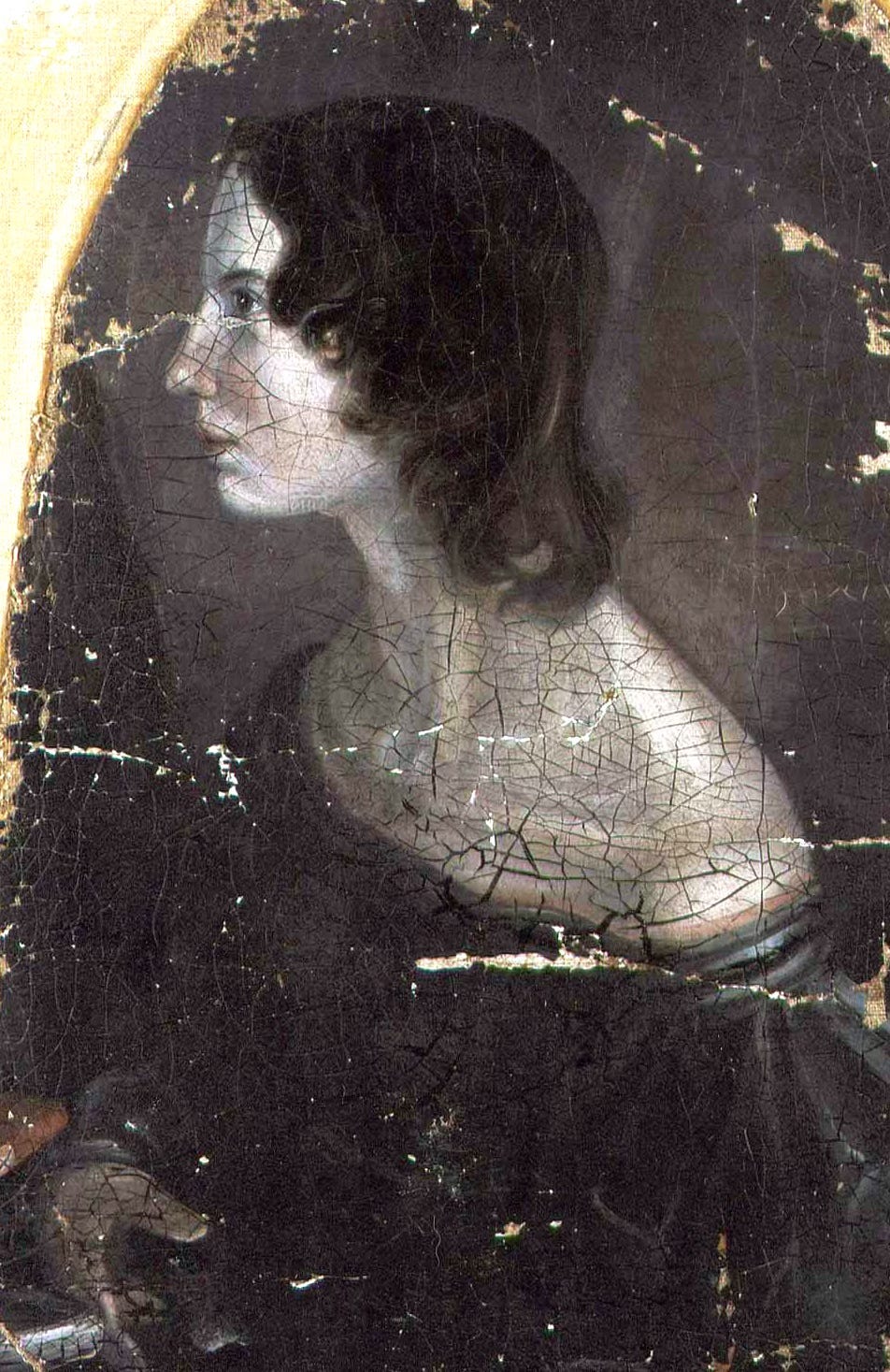
I once took a quiz to find out whether my personality was more “masculine” or “feminine.” The questions related to preferences, interests, childhood hobbies. Nearly all of my answers fit the “feminine” classification (I had never been interested in subjecting insects to fatal conjunctions of magnifying glasses and sunlight, for example, or tying strings around dragonflies’ bellies) except for one: I relished violent weather. An audience member in the vast theater of nature, it was for the thunderclap, the lightning strike, the avalanche, the cataclysm that I reserved my loudest applause. Storms stirred me; gusts thrilled me. The crashing of the cataract over the rocks, the howling sobbing moaning of wind in the treetops, the white whirling of a nor’easter, fire, flood, and famine: my soul could never fail to be swept up in what seemed the most passionate expressions of a divine power.
I remembered this answer while reading This Dark Night, Deborah Lutz’s new biography of Emily Brontë, because I feel certain Emily would have answered similarly. “Who hath gathered the wind in his fists?” she stitched in a sampler, part of a quotation of verses from Proverbs, at the age of ten or eleven. The answer is God, of course, but it could also be Emily herself, patron saint of all things wuthering and wildered.
Like Wuthering Heights, Lutz’s biography begins with a storm. Emily witnessed it early in childhood, and she captured its memory in a poem written twelve years later, where “Rivers their banks in their jubilee rending / Fast through the valleys a reckless course wending / Wilder and deeper their waters extending” engender “Darkness and glory rejoicingly blending” and “Man’s spirit away from its drear dungeon sending / Bursting the fetters and breaking the bars.” What exhilaration is here in these rollicking, thundering dactyls! What a joy and tumult in these forces of nature that bring together “bright flashes” and “deep gloom,” “midnight” and “noon,” “Earth” and “heaven,” and cause “man’s spirit” to break out at last, to burst as if into song!
But before Emily Jane Brontë could burst into song, she had to be born—in 1818, the penultimate of six children—and she had to be born to Patrick Brontë and Maria Branwell. Patrick was an Irishman who through his own hard work, drive, and intelligence emerged out of a poor family of ten children to earn a “sizar’s place” (scholarship) at Cambridge. “[D]id he get a sizar’s place at college…?” Lockwood, the visitor to Wuthering Heights asks the housekeeper Nelly regarding Heathcliff. Indeed, something of Patrick’s self-fashioning—he metamorphosed his name, written in Irish as Ó Pronntaigh, into Prunty, Brunty, Branty, Bruntee, Bronte, Brontè, Bronté, Brontê, Brontē, and Brontě before his famous offspring cemented it forever as Brontë—abides in Heathcliff. There is something of his marriage to Maria, too, the story of a poor self-made man courting a woman from a wealthy, more socially prominent family, that made its way into both Wuthering Heights and the backstory of Jane’s parents in Jane Eyre.
Together, Patrick and Maria blent their love of books and poetry (Patrick published novels and poems; Maria was an avid reader whose lending library contained many of the lurid gothic tales popular at the time) into a strong literary current that flowed into their four children who lived to see adulthood. In 1820, Patrick was made perpetual curate at the church in Haworth, and the Brontës moved into the parsonage. They left behind much of their social life, but for the toddler Emily, at least, this was no great loss: the moors and the skies, the wind, the rain, the snow, the stars, the moon, the birds would become lifelong friends.
It has been said that genius inheres more easily in those who have lost one parent or both early on. Perhaps this is because such early firsthand knowledge of death leaves an indelible mark, makes life graver, greater, stranger, brief. Perhaps this is because grief turns one inwards, allows one to become better acquainted with oneself. Perhaps this is because the absence of a parent notches up the survival instinct, a sense of independence, a need to make something out of oneself. Whatever the case, Emily, aged three, bore witness to her mother’s several months of illness, her death, her burial. The family vault in St. Michael’s Church is a place Lutz and Brontë revisit again and again, for it would be opened first for Emily’s mother Maria, then reopened for more maternal figures: Maria Jr. and Elizabeth, the two eldest sisters, dying—like Helen Burns from Jane Eyre—of illness caught at boarding school four years later, and their Aunt Branwell, their mother’s sister who came to live with them, 21 years later.
What is the crucible in which Emily’s genius was formed? The children—Charlotte, Branwell, Emily, and Anne—made up stories together, inspired by newspapers, literary journals (they loved Blackwood’s Edinburgh Magazine), toy soldiers, Water Scott, polar explorers, foreign geography. After the two younger siblings, Emily and Anne, abandoned the world of Glass Town, they created a land called Gondal, a land Emily kept one foot in even into her mid-twenties. Though Patrick prioritized his son’s education, he was encouraging towards his girls; they learned needlework, piano, French, and Latin. They read to each other by the fire. They wrote and wrote. “[W]e were wholly dependent on ourselves and each other, on books and study, for the enjoyments and occupations of life. The highest stimulus, as well as the liveliest pleasure we had known from childhood upwards, lay in attempts at literary composition,” reflects Charlotte years later.
To our modern eyes, their lives seem lonely, threadbare, isolated—Emily’s especially. Until the age of twenty-four, when she and Charlotte went to boarding school in Brussels, her contact with the outside world, her formal education were sparse. She did not make friends as Charlotte did, or seek employment in the wide world as a governess like Anne; solitude was an almost physical need for her. “Liberty was the breath of Emily’s nostrils; without it she perished,” says Charlotte. Perhaps this is why prisons and jails, fetters and chains are everywhere in her poems. “Why all this beating of wings?” Anne Carson asks in “The Glass Essay,” but for an intellect as capacious as Emily’s, an imagination as variegated, life itself must have seemed a prison.
Both Cathys in Wuthering Heights long to escape their homes, their marriages, anything that limits them; they would rather be out on the moors, rambling, taking in the bracing ventilation: “And that wind sounding in the firs by the lattice. Do let me feel it—it comes straight down the moor—do let me have one breath!” says the elder Cathy. As for Heathcliff, it is his own body he seeks liberty from, his own mortal, human frame, the flesh that pens up spirit. He would break the prison of his bones, he would break Cathy out of the grave, an unearthly, peat-preserved bog body, he would unite them into one being and dissolve all walls between souls.
But the need for solitude went only so far as humans were concerned: animals did not impair solitude, seemed even to extend liberty. They were the soulmates of Emily’s native wildness. In her diary paper of 1834, she mentions feeding Snowflake the cat, Jasper the pheasant, and Rainbow and Diamond the geese. Of her extant drawings, three depict, in fine, sensitive detail, the merlin hawk Nero, whom Emily found on the moors with an injured wing and nursed back to health, the terrier Grasper, who appears in profile sweet and alert, and the vast mastiff Keeper, whose ferocity found something kindred in Emily. When she died, he padded along in her funeral procession; in her absence, he went to her bedroom day after day to look for her.


“Emily must have been a remnant of the Titans—great-grand-daughter of the giants who used to inhabit the earth,” muses Elizabeth Gaskell, the Brontës’ first biographer. Lutz doesn’t make such surmises, but she also doesn’t shrink from showing us an Emily whose soul was edged in iron, whose courage was hewn of millstone grit. Like nature itself, like the ragged northern landscape, Emily could be cruel, stern, inexorable. There are the famous stories, how, at six, when asked the best way to discipline her brother Branwell, she told her father to “reason with him, and when he won’t listen to reason whip him”; how, at fourteen, bitten by a dog, she marched into the kitchen, grabbed an iron poker from the fire, and cauterized the wound herself; how, at twenty-eight, when Branwell’s bed caught fire, she hauled him out bodily and doused the bedclothes with water. Emily could “exercise a sort of tyranny” over the older Charlotte, both in childhood and adulthood. It was Emily, not Branwell, Patrick taught to shoot a gun.
Biographers have had a tendency to linger on these scenes of wound and flame, drawing out their shock value. Not Lutz. In her book, Emily’s flinty character is of a piece with domestic practicality. Love of solitude and good common sense made Emily the perfect housedaughter while Anne governessed and Charlotte lingered in Brussels and Branwell job-hopped and pub-hopped. In her will, Aunt Branwell had left the three girls £300 each, invested in the railroads that were springing up all over Britain, and Emily saw after the stocks. In one notebook, she was jotting down her investment activity, in another, her poems. Lutz’s attention to the tangible texture of daily life shows us how Emily did not just write during dreamy, cloudgazing hours en plein air but in every minute she could spare: “kneading dough… waiting for the kettle to boil, the bread to bake, or while she worked on clothes with the tally iron.” She found ways to minimize obligations, distractions, and invasions of family drama when her siblings returned home.
Reunited, the sisters confluenced their creativity into one roiling flow. Half-hearted plans for forming a school were abandoned, and they quickly moved on to what would suit them better: publication, first of a book of poems, then of novels. Emily had already been neatly copying poems into a notebook, formatting them as if for publication, and in 1846, Poems by Currer, Ellis, and Acton Bell appeared. Though only two copies sold, the sisters chugged on with the novels they had started in 1845, the genre most likely to bring in good income.
Where did Wuthering Heights come from? Certainly its seed must have been Gondalian in origin. But practicalities nourished it, too—rejection resulted in revision, Lutz believes, doubling the length of the book and adding the second part that follows the second generation. Emily presaged her singular novel in an essay written in Brussels, where she declares that “if hypocrisy, cruelty, and ingratitude are exclusively the domain of the wicked, that class comprises everyone.” Yet not everyone was open to such an uncompromising vision, and when the novel was published, the reaction was largely one of distaste and discomfort. Little over a year later, Emily would succumb to illness and die at the age of 30. “I thought it was very possible that she might be with us still for weeks and a few hours afterwards she was in Eternity,” says Charlotte.
Now it seems that Emily’s place in Eternity has never been more assured. Jane Eyre might have carried off all the palms at the time, but it is Emily and her work that increasingly bewitch us. Even then, we are still learning to be her contemporaries. Wuthering Heights has only one passable adaptation true to the spirit of the novel; the one made this year is a farce. Her poetry is still not as widely read as it should be. A 2022 film has to concoct an affair between Emily and the young new curate William Weightman, in which Emily stops writing because Weightman ends their relationship and has to be exhorted by a dying Weightman to continue, as if Emily Brontë needed a romantic liaison with a man to write or to understand the passions of the human soul. In the face of all this, Lutz’s biography is a refreshing corrective. She does not afflict Emily with anorexia or psychologize her to shreds, as other biographers have done. She acknowledges Emily’s individuality without making her some kind of freak. She notes outside circumstances without imputing Emily’s brilliance entirely to them. If she dredges up no new facts, she arranges and narrates old ones with invigorating liveliness and keen sympathy for Emily the writer, Emily the person.
What, then, is the portrait that emerges? It is Emily in the “kitchin,” Emily on the moors. Emily is playing with her siblings, reading with them, writing with them, learning with them. Emily is gazing at the wide blue sky, and in her pockets are feathers, pencils, scraps of paper. Emily is drawing, painting, playing Beethoven on the piano. Emily is writing her diary paper, she is “pilling the potatoes.” Emily is tucked in the nook of her narrow little room, 5’ 7” on the bed that stretches wall to wall, “whaching” weather through the tall window. When Emily’s early death comes, we are sad, especially when Lutz suggests Emily may have made a start on a second novel. Even the manuscript of this work does not survive; what we have instead are one perfect novel and nearly 200 poems, more than a handful of them guaranteed by their vigor and beauty and language and strange splendor a spot “in Eternity.”
The three Brontë sisters are all novelists, and fine ones, but it is Emily who is the only real poet. Even in her novel, it is a poetic vision she expresses, not a social or political or romantic one. It is a vision of passion as a ruling power, both in its good and bad aspects, of soul as a great gust that blows down the fences of body and world and regains its home in infinity. Heathcliff and Cathy, yearning for one another across moors and graves, across life and death, are something more than human. They are like the gods of a private mythology. They are cruel and amoral beings, forces of nature taking the form of mortal bodies.
Emily would have been “a great navigator,” noted Constantin Héger, her teacher in Brussels. But indeed she was a “great navigator,” venturing into regions untried, unafraid of the hard frost and the thorny thicket; if the soul has a polar explorer, it is Emily Brontë, intrepid, adventuring, willful, strong. “I’ll walk where my own nature would be leading: / It vexes me to choose another guide,” she tells us, and already she is up there in the distance, following a trace of starlight, the breath of a breeze.

Dear readers, it seems that 2026 is shaping up to be the Year of Emily Brontë, which I absolutely don’t mind at all! I hope you enjoyed reading this one. As always, I love hearing your thoughts in the comments!
Very enjoyable review!
"To our modern eyes, their lives seem lonely, threadbare, isolated"—this gave me a pang, because, as I was growing up (in a situation where I didn't know anybody within ten years of my age in either direction) I got obsessed with the Brontës because their tiny community of friendship seemed like the opposite of loneliness. Specifically, I envied their shared world of the imagination, Gondal. I became a bit of a yearning specialist in paracosms—besides the Brontë's Gondal, there was the Lewis brothers' Boxen, the Ejuxria of Coleridge's three children, and the De Quincy's Gombroon and Tigrosylvania. To this I would add (though it's different, somehow it's also the same) the political pseudonyms, Demosthenes and Lock, that Valentine and Peter Wiggin invent in Orson Scott Card's *Ender's Game*. I've never been able to imagine a more fully sociable world than being an intelligent child living in a world of the imagination that's also shared.
Anyway, great post.
“I once took a quiz to find out whether my personality was more “masculine” or “feminine” … Nearly all my answers fit the “feminine” classification.”
Oh, I think your moodboards are better than any test for revealing that, Ramya!
Great writing as always. 👏