

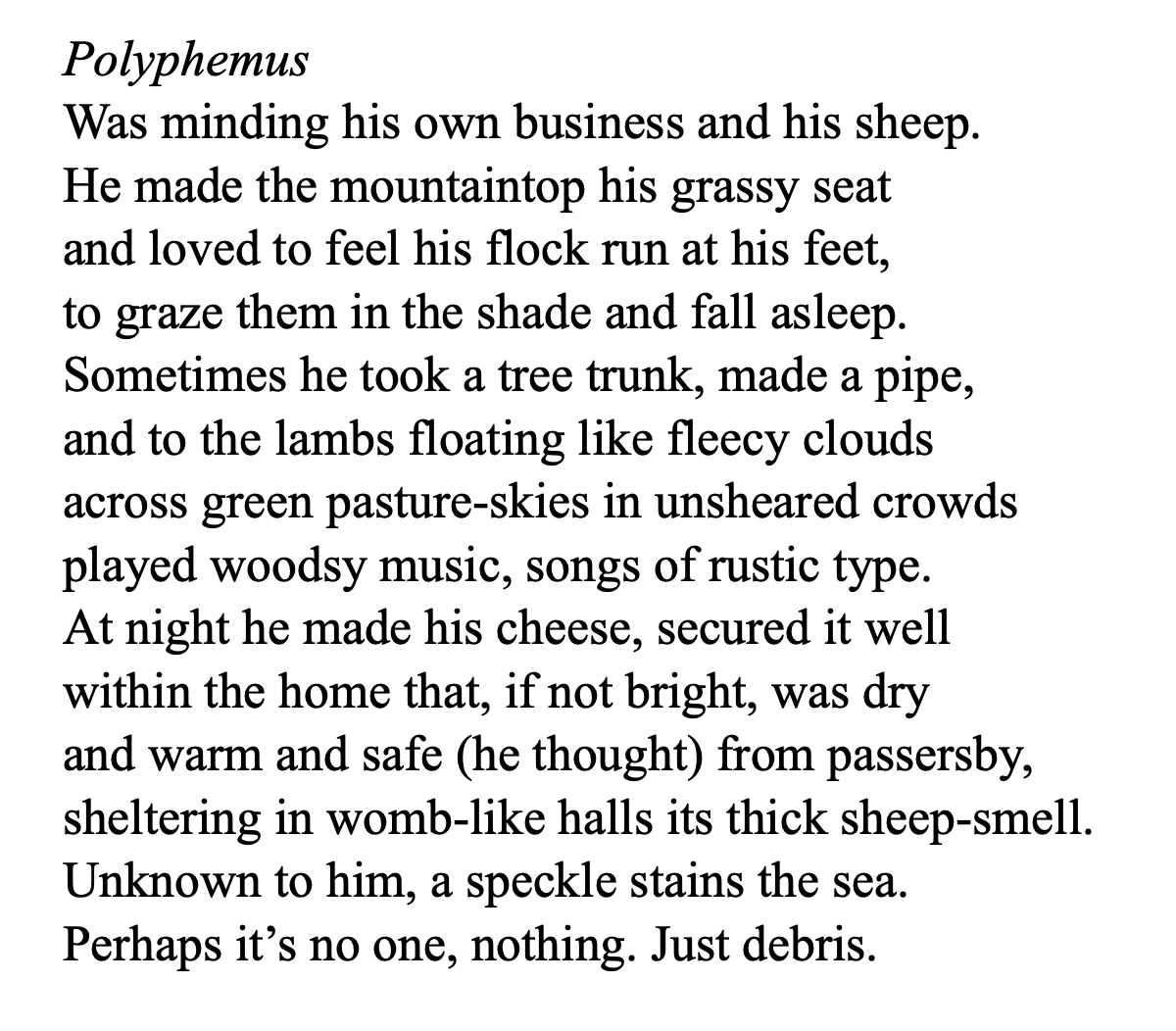
Polyphemus: A Sonnet
sympathy for the Cyclops

—
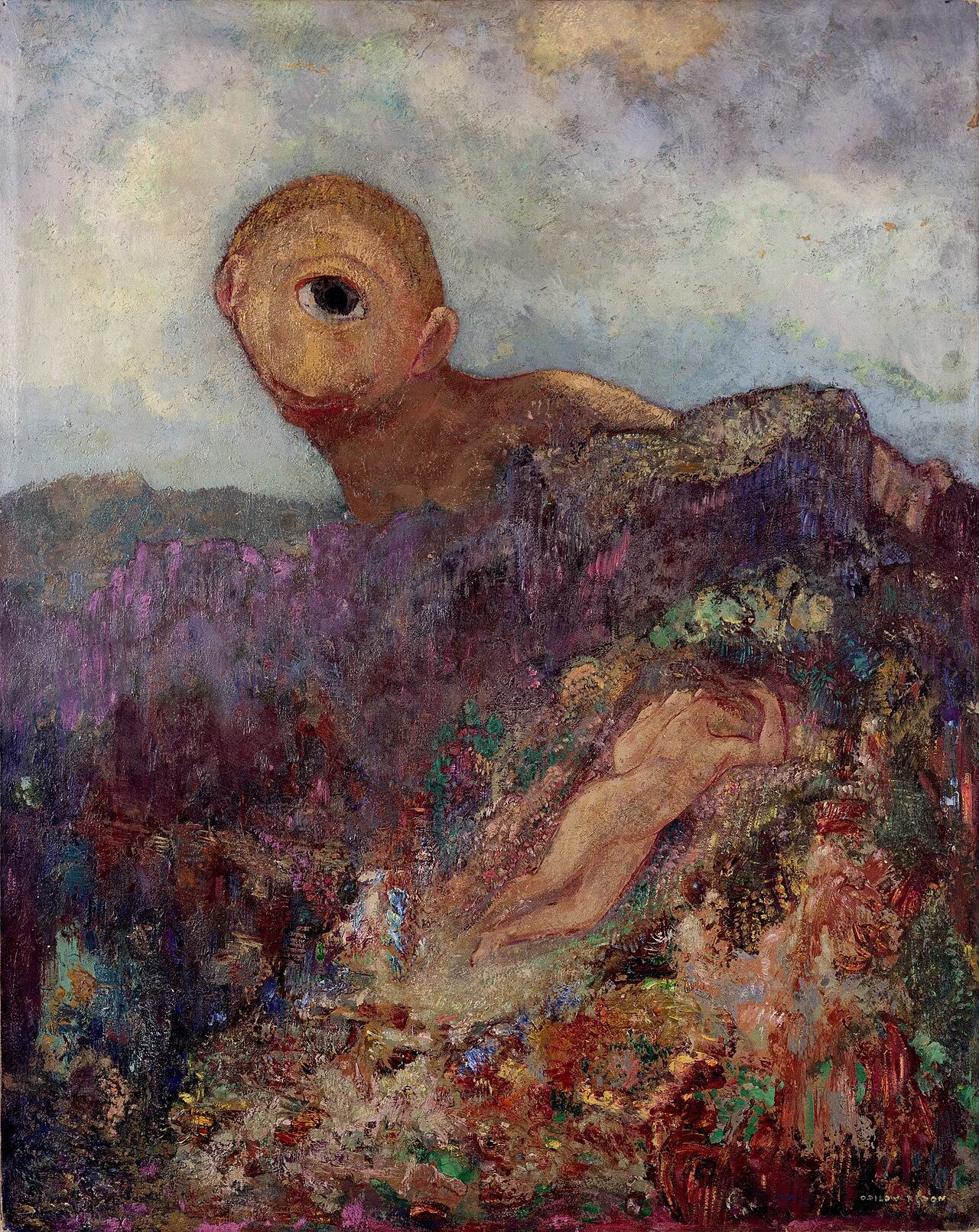
Polyphemus, the Cyclops (one-eyed giant) from Homer’s Odyssey, is the son of the sea god Poseidon and the nymph Thoösa. While returning (or attempting to return) home from the Trojan War, Odysseus and his crew decide to explore the island where the Cyclopes live and find Polyphemus’ cave. Inside are yummy things like cheese, which lie ripe for the taking while Polyphemus is out herding his flock. After eating a bit of the cheese, the men propose to make off with the cheese and lambs and sail away, but Odysseus, always up for some mischief, wants to see if Polyphemus will give them the gifts of xenia (guest-friendship) that custom dictates. Polyphemus comes home with his flock, does his chores, and then is surprised to see these strangers in his home. Odysseus asks for the gifts; since Zeus looks out for guests, Polyphemus should give them something. But the Cyclopes are a wild people; they have no agriculture, no civilization, no ships or shipbuilding, no law, no fear of Zeus. Polyphemus instead eats two of Odysseus’ crew, dashing their brains out on the cave floor. The next morning, Polyphemus has two more men for breakfast and, when he comes back from the fields, another two men for dinner.
But in the Cyclops’ absence, crafty Odysseus and his crew have been sharpening Polyphemus’ giant walking stick. Odysseus treats his host to some wine—a human drink to wash down human meat—and gets the Cyclops drunk. Attempting to trick literature’s trickiest man, Polyphemus promises a gift in return for Odysseus’ name, and after Odysseus states his name tells him he will give him the “gift” of eating him last. But the name Odysseus has given is “Οὖτις,” “Nobody,” and when Polyphemus falls asleep and Odysseus and his men blind him with the sharpened walking stick and Polyphemus calls out for help, his fellow Cyclopes fail to come to his aid: after all, “Nobody” is attacking him. Easier to outmaneuver than a one-eyed giant is a no-eyed giant, and Odysseus and his men make their escape.
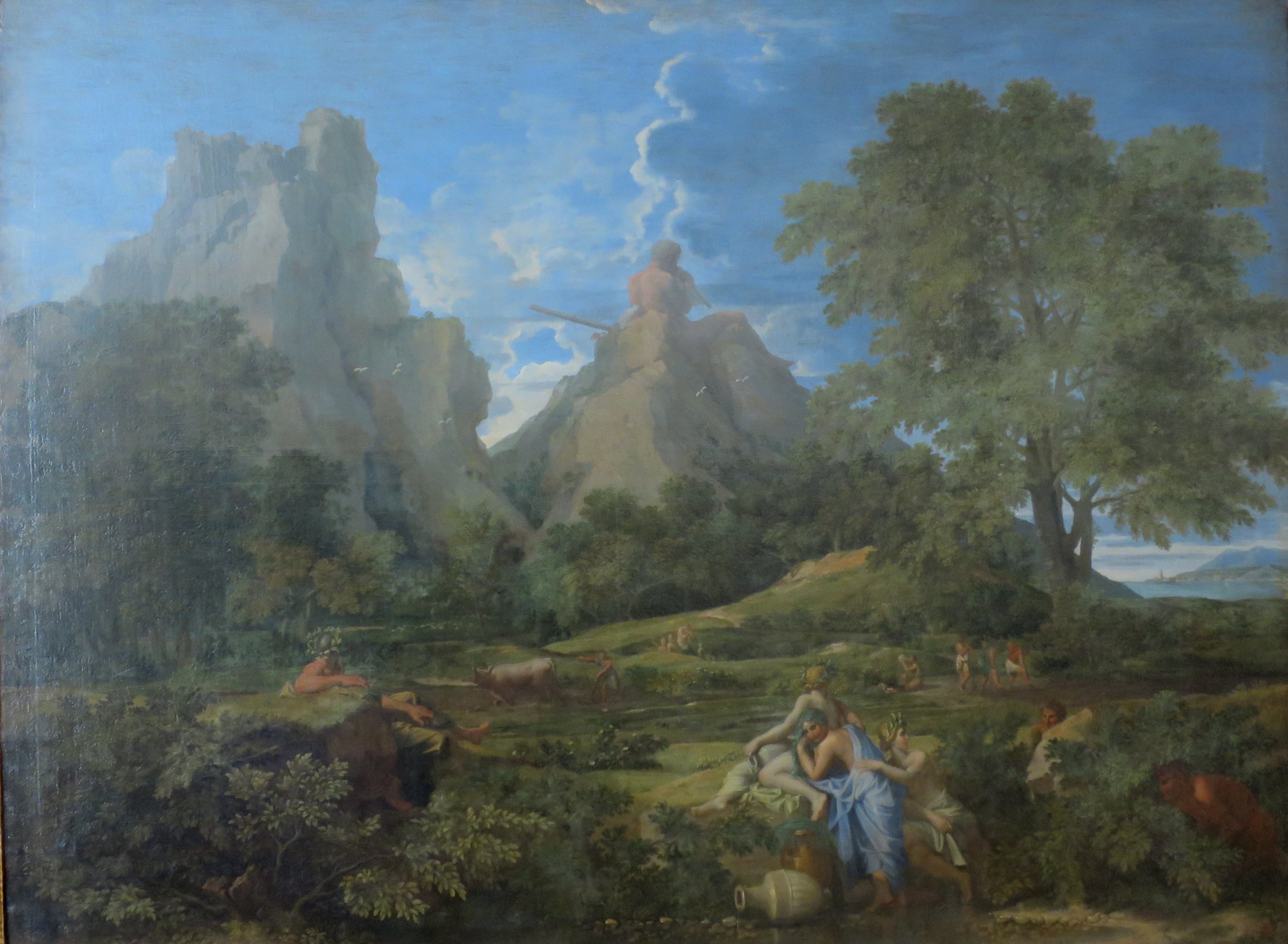
After my husband and I went to see Christopher Nolan’s adaptation (which I wrote about here), my husband said that he felt sorry for poor Polyphemus. It wasn’t his fault these humans invaded his home and started eating his cheese. I was reminded of a story from Ovid’s Metamorphoses I’d read in Latin class in college that’d made me feel similarly sympathetic for the Cyclops. In that story Ovid, drawing on earlier Greek sources, tells of how Polyphemus fell in love with the nymph Galatea, who already had a boyfriend—the handsome youth Acis. Galatea, telling the story, has the air of the pretty, popular girl in school making fun of the loser nerd who has a crush on her. Yet Ovid’s Polyphemus is someone we not only laugh at but feel for—especially, I think, in these lines:1
nec, si quaesieris, odium Cyclopis amorne
Acidis in nobis fuerit praesentior, edam:
par utrumque fuit. pro, quanta potentia regni
est, Venus alma, tui! nempe ille inmitis et ipsis
horrendus silvis et visus ab hospite nullo
inpune et magni cum dis contemptor Olympi,
quid sit amor, sentit validaque cupidine captus
uritur oblitus pecorum antrorumque suorum.
iamque tibi formae, iamque est tibi cura placendi,
iam rigidos pectis rastris, Polypheme, capillos,
iam libet hirsutam tibi falce recidere barbam
et spectare feros in aqua et conponere vultus.
caedis amor feritasque sitisque inmensa cruoris
cessant, et tutae veniuntque abeuntque carinae.

If you should have asked, I could not say whether hate
for the Cyclops or love for Acis was more present in me:
both were equal. Oh, how great is the power
of your rule, nurturing Venus! Indeed, rough
and shuddered at by his own forests and seen by no stranger
without punishment and scorning great Olympus and the gods,
he feels what love is, and, seized by strong desire,
he is burned, forgetting his sheep and his caves.
And now you care for your appearance, now you care to please,
now, Polyphemus, you comb your rigid hair with rakes,
now it pleases you to trim your bristly beard with a scythe
and to look in the water and compose your wild expressions.
Love of slaughter, savagery, and great thirst for blood
cease, and ships come and go safely.
In Homer’s depiction, Polyphemus is the violator of xenia, which differentiates the lawless, godless Cyclopes from humans. But the cave is his home, and wouldn’t you be a little miffed to find uninvited guests helping themselves to food you worked so hard to make?
Dear readers, I hope you’ve been doing well! I haven’t posted my poetry in a while here, but I thought this would be a nice follow-up to the last post, where I reviewed the Nolan film. As always, please let me know your thoughts in the comments, as I love hearing from you, and like this post and share with a friend if you enjoyed!
Also, here is a (very silly) bit of light verse I posted on Notes, inspired by Emily Wilson’s viral review of Nolan’s film and one review in the Boston Globe where the reviewer’s bladder seemed in terrible danger:
Met 13.755–68, my translation.