

Christopher Nolan's Odd-yssey
Nolan tells Homer's old story for our modern times. But does he succeed?

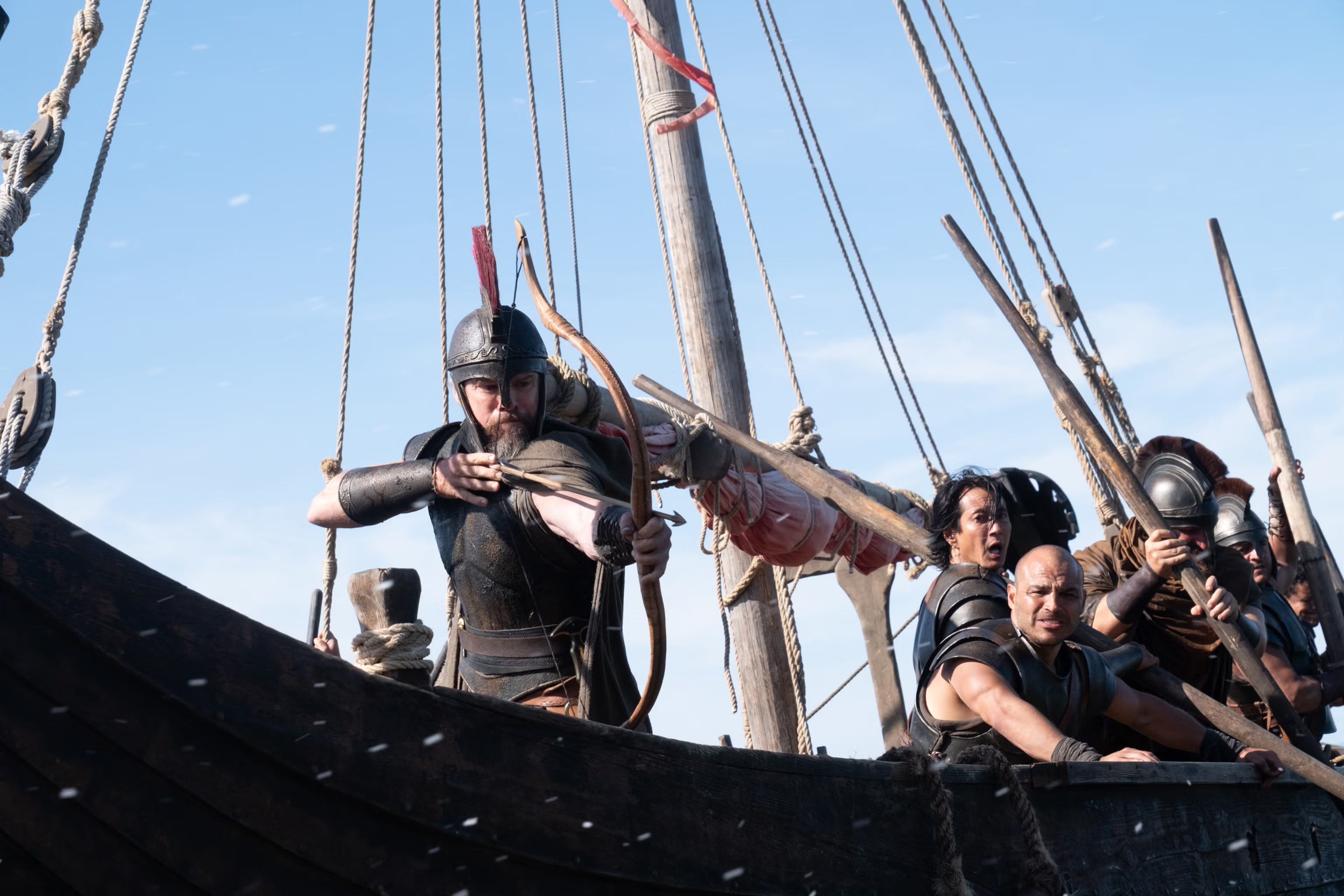
Shakespeare may have had “small Latin, and less Greek,” but most students today have no Latin and no Greek. Their knowledge of classical myth comes filtered, then, by the choices of others—by the choices of translators and teachers, re-tellers and re-interpreters. Christopher Nolan is one such re-interpreter; Nolan’s The Odyssey may very well be many’s first direct encounter with the narrative of Homer’s Odyssey. And what an encounter it is! Loud, bold, epic, real, it is like Odysseus’ own encounter with Lestrygonians or Cyclopes.
I’ve always had the strong suspicion, when it comes to adaptations of Homer, that the epics were best approached obliquely. Jean-Luc Godard’s Contempt (1963), where Fritz Lang, played by Fritz Lang, helms an adaptation caught in the more contemporary battle between artistic integrity and commercial profit, where the Greek gods are shown only as vast white effigies of marble, where questions of marital faith and fidelity are tested by a sellout-scriptwriter Odysseus and his listless inscrutable blond Penelope. The Coen brothers’ O Brother, Where Art Thou? (2000), where an escaped-convict Odysseus and his companions wander through the Mississippi Delta of the 1930s, where the songs of bards in ancient halls become the folk tunes of guitar strummers in radio stations. Theo Angelopoulos’ Ulysses’ Gaze (1995), where a Greek-filmmaker Odysseus voyages through the Balkans on a quest for long-lost film reels. But here Nolan approaches the Odyssey head-on; here he strings his bow and aims his arrow straight at the dead center of Homer’s poem; here he has at last given us a truly epic adaptation of an epic.
It may be pedantic to compare epic with epic, to put ancient distillation of an oral tradition up against modern visualization of a written translation. It may be pedantic, and it may be pretentious, and it may be petty; after all, even Homer, when he invokes the Muse, says, “Speak, too, to us”—in Emily Wilson’s translation (the one used by Nolan) put more strongly as “tell the old story for our modern times.” To suit the demands of “our modern times”—that is to say, the demands of IMAX—Nolan had to keep the old story under three hours. For two hours and 53 minutes he weaves the tale of the return of the Trojan War hero Odysseus (Matt Damon), whose wife Penelope (Anne Hathaway) and son Telemachus (Tom Holland) have been waiting for him twenty long, uncertain years. Odysseus ended the war in its 10th year, cooking up the device of the Trojan horse; for the next 10 years, he wanders, blown off-course by wind and wave and angry god. Meanwhile in Ithaca, suitors courting Penelope have brought disorder to Odysseus’ home. The household needs its head, Ithaca its king, badly. Penelope, not entirely convinced that her husband is dead, will not choose a suitor, but not entirely convinced that he is not dead, either, cannot send them away. Telemachus, a baby when he last laid eyes on his father, stands on the cusp of adulthood, desperately wanting to prove he is no longer a boy but unsure, in his father’s absence, of how to become a man. For him this is a coming-of-age story, one that will test him as the Trojan War tested his father.
Nolan’s omissions and additions may seem rather trivial. These revisions, however, add up to a larger vision—a vision of the Bronze Age world, a vision of Odysseus, a vision of what the ancient story means for us modern people. That the Ciconians are left out, for example, or that the cannibalism of the Lestrygonians is kept out perhaps matters little. By choosing to exclude the Phaecians, though, Nolan excludes the scenes of Odysseus listening to his own story, the tears pouring down his face, the Phaecian king questioning him about these tears, Odysseus then sharing his story—not to one person only, not to Calypso only, as he does in the film, but to a whole hall of people, essentially stepping into the role of poet-storyteller himself. The Phaecians, in the poem, after hearing his misadventures, give Odysseus a ship and a crew, and with their help he reaches home quite easily. In Nolan’s version Odysseus skips Phaecia and goes straight from Calypso’s Ogygia to his own Ithaca, following the advice Calypso (Charlize Theron) gives him. “You’re a man who needs to control his fate,” she tells him, but to get home he needs to relinquish this need, trust to the gods, let the sea and the wind carry him to where he needs to go.
This is a strange message because it must mean something that out of his whole crew, this man, Odysseus, this crafty man favored by Athena, goddess of crafts and crafty people, this man who controls, is not controlled by his circumstances, this man who is not the strongest or the hardest or the largest or the most fearsome but certainly the most strategic, alone survives, alone returns home, alone lives to tell the tale. Nolan exalts a relinquishing of control because in our modern world humans control so much; in Homer’s time, humans controlled so little, which is why the moody, capricious gods played so large a role in human fates. In Homer’s world you have no way to contact those you have departed from; adrift, lashed by howling storms, driven now here, now there, you have no way of knowing if you are ten days from home or ten years, if the people you meet will be friend or foe, if your own wife will welcome you with open arms or with a lover and a dagger in your chest, if the shore you have washed up on is even your own. So you must stay tricky and sharp and smart, allow your mind to spool out in many ways in this world of many ways. Athena loves Odysseus because he is like this, and helps him because he is like this. Homer’s Odysseus is the triumph of man’s ingenuity over an uncertain world.
Oddly,1 though Nolan’s Odysseus surrenders himself to the gods’ will to get back home, we do not see much of the gods at all. Nolan’s Odyssey is rooted in the “real” world, gritty and grimy and dark and tangible. Circe the witch (Samantha Morton) uses no magic wand to turn men into pigs but effects the metamorphoses with her bare hands, molding and sculpting and pressing skin and flesh and bone until noses become snouts and bodies become crouched and elongated and pink. It would be silly, then, in Nolan’s world to see Zeus and all the rest in council on shining Olympus, or Hermes strolling along the seashore to deliver a message to Calypso.
But Nolan’s “real” world omits some of the humor and the whimsy and the poignancy and the strangeness of the poem, those things that distinguish it from the war-whirl of the Iliad, and in doing so omits some of the epic’s most vivid scenes. Odysseus here does not give his name to the Cyclops Polyphemus as Nobody so that, calling out for help, Polyphemus will say, “Nobody is attacking me,” causing the other Cyclopes to ignore him and Odysseus to escape him; Odysseus here does not reveal his real name to Polyphemus as he is leaving, a moment of hubris he will pay for when Polyphemus prays to his father Poseidon to curse the man he now knows as Odysseus. Missing this, we miss one of Western literature’s best-known jokes; we miss brushstrokes that daub vivider color onto Odysseus’ portrait, painting him as superbly clever and yet not so clever he rises above the pride of having to attach his name to his clever acts.
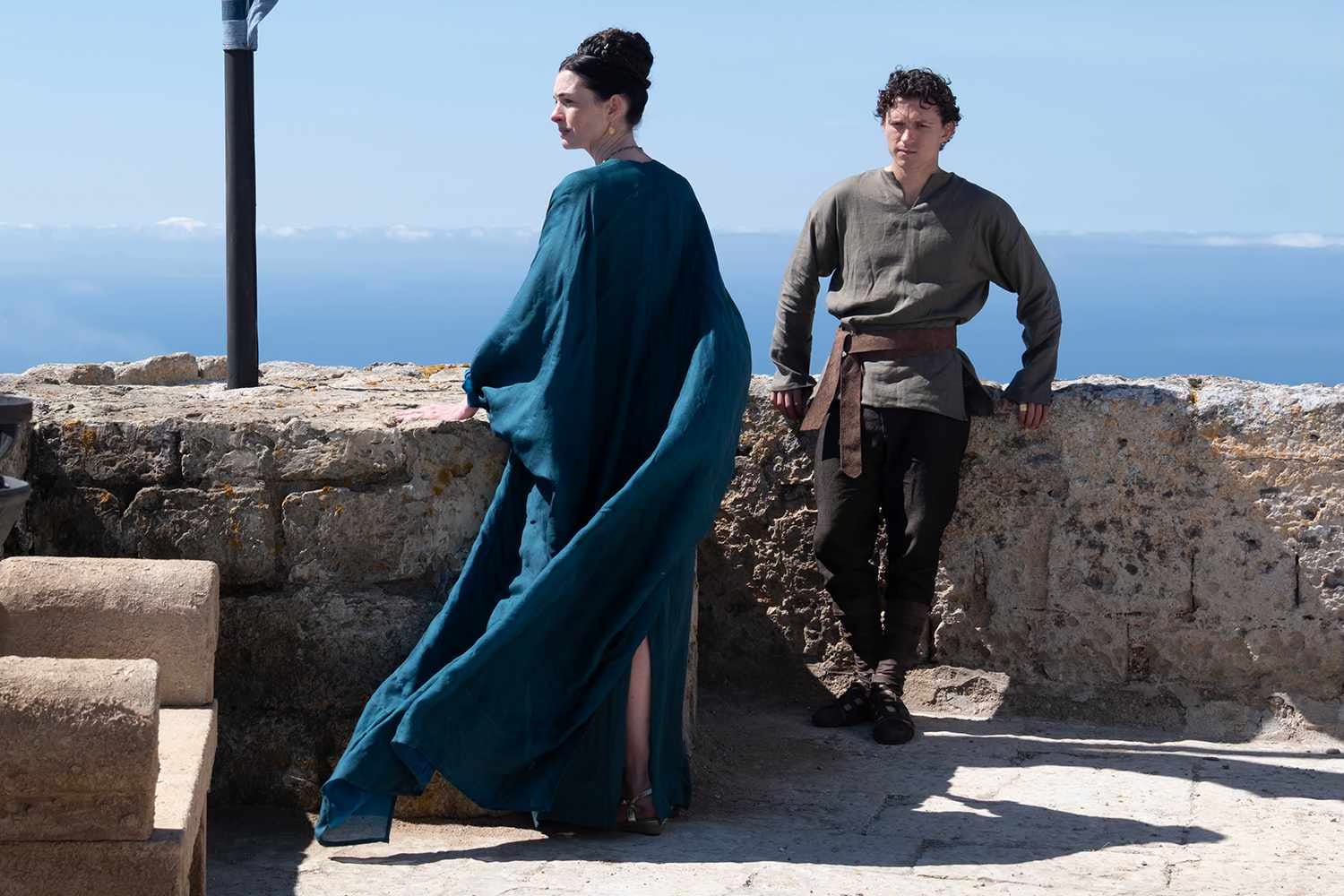
Another chance to reveal character is missed in the exclusion of literature’s most memorable bed: the marriage bed of Odysseus and Penelope was built by Odysseus himself, who carved one of its posts out of an olive tree still rooted to the ground; the bed is as firm as the marriage. But Penelope tests her husband just as her husband has tested her. She asks the nursemaid Eurycleia to have the bed moved for the stranger (Odysseus) to sleep outside the bedroom. Odysseus is incensed. At once he demands to know who has untethered his marriage bed, and by this Penelope knows this is indeed her husband; no longer restraining herself, she flings her body into her husband’s long-absent embrace. Nolan gives us an intelligent Penelope, a grieving, loving Penelope, at one point, strangely, a sort of girlboss Penelope who speaks of her “knowledge” and “years of experience” on the throne as though gunning for the corner office, but without Homer’s bed scene we don’t see just how well-matched, how equally clever, equally strategic, equally wily, perfect for each other husband and wife are. Other epic couples are beset by murder and betrayal (Nolan wonderfully weaves in Agamemnon’s sacrifice of his daughter Iphigenia as a motive for his wife Clytemnestra’s murder of him, which the poem unfortunately does not), but Odysseus and Penelope will go to any lengths to be only each other’s. Nolan tries to replace the bed with a gold pin of Athena Penelope gives to Odysseus before the war and which he carries with him, but there is something in this so conventional, so dull, so much less fun.
Other departures involve other members of Odysseus’ family. Visiting the spirits of the dead, Odysseus has no meeting with the spirit of his mother, who died of heartbreak waiting for her son to come home, or reunion on Ithaca with his father, now aged and stooped and tearfully elated to see after two decades his only child. The pathos of such moments in the film instead rests on the canine shoulders of the poor mistreated dog Argos. Most unfortunate of all, Telemachus, for some arbitrary reason, does not fight the suitors at home side-by-side with his father, does not plot their death together with him, but is instead relegated to an upstairs storeroom tussle—I would have liked to see father and son ridding their home of its threat together, son marveling at father, father marveling at son. Nolan’s ending, a surprise and a departure, finally graduates Telemachus to manhood, but rather abruptly.
Many of the details I missed—the conversations between Athena and her father Zeus, the “Nobody” joke, the olive-tree bed, the way Athena scolds the princess Nausicaa for her slovenliness so the girl will go to a stream and discover Odysseus, the sarcasm of Eumaeus, the dream of Penelope, the omens of birds, Menelaus’ attempts to capture the ever-changing Old Man of the Sea Proteus, the tender way a servant helps the blind poet Demodocus reach for his lyre, the part of Tiresias’ prophecy about the people who live so far inland they’ll mistake an oar for a winnowing shovel, the twitching legs of the 12 slave girls hung from the rafters for disloyalty—all this may not amount to very much. But all this is poetry.
What does Nolan replace it with? The film has a thesis about the end of civilization brought about by the end of what it calls “Zeus’ law.” “Zeus’ law,” equated in the film by one character anachronistically, glibly, with the Golden Rule, is really the Greek concept of xenia (guest-friendship), which outlined certain obligations of host to guest and of guest to host. Odysseus, the film argues, violated xenia when he came up with the Trojan horse stratagem—a trick gift that spelled doom for Troy. The stratagem ended the war, but at what emotional cost for Odysseus? What moral cost for society? This is why the suitors have overstepped the rights of guests and everything is in chaos—not because Odysseus is gone from home but because of what he has done while away.
Nolan’s Odysseus has a quality Homer’s does not: the quality of introspection. Odysseus stands in for all veterans—shaken, guilty, lost, remembering, wanting to forget. War is awful. It tears apart cities and minds and souls and norms and societies. It is fought for silly and selfish reasons. It makes us do the worst with our best qualities. Yet what is the solution to this supposed end of civilization? Based on the actions of Penelope and Odysseus, it is to escape, leave it all behind, let the sons sort out the sins of the fathers.
The film says least when it speaks most. Trying to say something, it comes across as too pat, too glib, too Hollywood. When dialogue and argument recede, something silent and strange and unspeakable and far deeper comes to the surface. The pulsating score made its way under my skin. The beggar-Odysseus stringing his bow and shooting his sure arrow through the axeheads made my blood leap. The image of the swift ship tossing on the wine-dark sea, its red sail unfurling triumphantly, took my breath away. This, too, is poetry. And it is poetry only the movies can sing.
Dear Readers, I always love hearing your thoughts in the comments! Liked the film? Hated it? Haven’t seen it? Don’t want to? Let me know!!
Further Reading on the Odyssey

Must resist the temptation to put “Oddysseyly”
ah! great review Ramya. After reading your review, I feel I should see the movie!