


This is an installment in the section Friday Frivolity. Every Friday, you’ll get a little micro-essay, plus a moodboard, 3 things I’m currently in love with, words of wisdom from what I’ve been reading lately, a shimmer of poetry, a “beauty tip,” and a question to spark your thought.
—
On Clouds
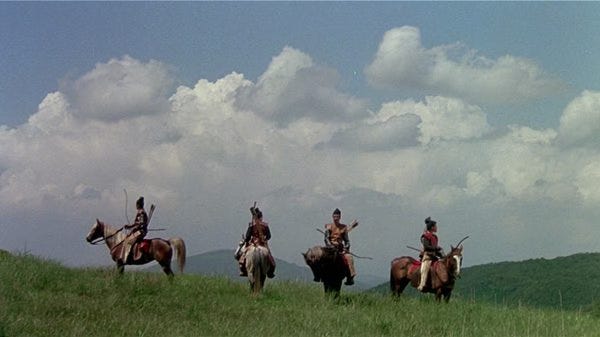
Akira Kurosawa’s Ran (1985) begins with a meeting in the undulating green mountains of Japan, rendered in lush Technicolor. I’ve been thinking a lot about the Brontës recently, the way that Charlotte and Emily use weather to convey emotional weather: “bracing” ventilation for harrowing intensity, trees split by lightning for sundered relationships. Kurosawa reveals himself as a poet of clouds; in the first shot, they mass up behind four men on horseback in white, fluffy piles, pure as a summer day. Several times throughout this opening, Kurosawa cuts to the clouds, alone against the cerulean sky, in heaped, smokelike mounds, rising, unfurling, unrolling in thick scrolls that seem to spell out something more ominous than their snowy softness belies. Later, as the tragedy of the story confirms this foreshadowing, the skies become grey and dark, clouds take on the bloodied tinctures of sunset, layer into one sightless, sooty smog, are replaced by the smoke from burning buildings.
I’ve always thought it would be lovely to live on a cloud. How disappointed I was as a child when I learned that a cloud was not a solid thing, that if you tried to use one as a bed (surely the coziest bed in the world!), you’d fall straight through! Sometimes when I look up into the sky, I still long to be in that inaccessible cloudland, cloud-leaping to a misty castle half-hidden among the plumes. In Kalidasa’s 5th-century Sanskrit poem Meghaduta, a yaksa, or nature spirit, exiled for allowing an elephant to trample his master’s garden, convinces a passing cloud to send a message to his wife, who is far away in the Himalayas. He persuades the cloud by describing all the beautiful sights it will see along the way: villages and cities and rivers and plains, “mango groves that glisten with ripe fruit.” The cloud is the ultimate wanderer, the lone pilgrim, the paragon of travelers. It measures the distance between here and there, near and far; high above us but still visible, able to rise and descend, it has a godlike perspective on our human happenings and yet is still humble enough to relate to us.
Less positive associations color Aristophanes’ The Clouds, a satire of Socrates’ philosophy. The debtor Strepsiades enrolls in Socrates’ school, “the Thinkery.” Socrates summons a Chorus of Clouds to show Strepsiades that gods like Zeus don’t exist, and Strepsiades, mistaking the Clouds for new gods, begins to worship them instead. These clouds stand in for intellectual and moral obscurity, philosophical fog, academic vapor, the bloat of sophistic billowing, a source of rhetorical thunder and flashy lightning strikes of wit. They are “the patron goddesses of the layabout.”
Personally, I take offense to the term “layabout”—I prefer “free spirit,” “reverist,” “daydreamer.” There are times when the sun dazzles and we need something to soften its bright blaze. Cloudy mornings are the mornings that make me feel like I have permission to stay under the sheets and sleep in. There is no need to hurry, no need to do, no need to strive. One can relax and float and dream in the cloudlike atmosphere of the bed, letting half-formed thoughts pass lazily across the mind’s blue skies, shapeshifting, metamorphosing, unforming, transforming, and reforming, drifting and melting into thin ether, rarefied gossamer, diaphanous subtleties.
Clouds have always caught the eye of those professional dreamers, the poets. They defy description and yet demand it. “The clouds—if I could describe them I would,” Virginia Woolf wrote in her diary in August 1928, then made the attempt anyway: “one yesterday had flowing hair on it, like the very fine white hair of an old man.” I always remember Keats’s clouds in “To Autumn”: “While barred clouds bloom the soft-dying day / And touch the stubble-plains with rosy hue.” His fellow Romantics were equally taken—who does not associate the image of one white perfect cloud-puff drifting in a springtime robin’s-egg sky with Wordsworth’s “I wandered lonely as a cloud”? And Shelley penned a whole poem in the voice of a cloud:
I am the daughter of Earth and Water,
And the nursling of the Sky;
I pass through the pores of the ocean and shores;
I change, but I cannot die.
Emotions echo clouds and clouds take on emotions in Shakespeare’s Titus Andronicus, when Titus says to the raped Lavinia, “Or with our sighs we’ll breathe the welkin dim, / And stain the sun with fog, as sometimes clouds / When they do hug him in their melting bosoms.” Even science becomes poetic when it comes to clouds, the names of their classification always having for me a kind of mystical resonance: cumulus, stratus, nimbus, combining and commingling and compiling, like clouds themselves, into stratocumulus, cumulonimbus, cirrostratus. It was Luke Howard, a young meteorologist, who at the beginning of the 19th century devised this classification, inspiring not just one poem from the much older Goethe but a whole sheaf, in which “The spirit mounts above, and lives forever.”
Angel’s wings, bridal veils, swans’ feathers, moon’s haloes, nature’s curtains, hazy lace. The mutability of clouds must have been one of our chief forms of entertainment in the days before books and phones. Clouds were our original cinema, dashing ever-changing pictures upon the heavens’ silver screen. Our tragedies and our comedies find their natural actors in the clouds, performing their great dramas across the stage of the sky. Is there any happiness so pure it does not find its correlative in a floating cumulus, any lightness of heart that is not matched by those airy striations of cirrus, any wretchedness that cannot be echoed by the grim grey march of darkening thunderclouds?
If our souls have any kind of material form, it must be the form of clouds. In my more irreligious moments—that is, in my moments when I revert to the kind of wild paganism I had as a child—I think we become clouds when we die. I like to think of my father as one such cloud, gazing benevolently down on me, a little nearer, perhaps, to God.
Further exploration:
The color of the year, according to Pantone, just so happens to be “Cloud Dancer,” which Vogue explores through runway looks
Gustav Holst was inspired by the Meghaduta to compose The Cloud Messenger, which had its first performance in 1910
Speaking of the Meghaduta, I remember really loving how Victoria presents a verse from it in her newsletter (now behind a paywall, but I think you can claim a free post). Richard Hartz’s translation is here with a Sanskrit transliteration.
On Substack, you can read more about Aristophanes’ The Clouds at Classical Wisdom
This lovely little cloud comic by ND Stevenson brought me a lot of joy
I really love clouds in the paintings of John Constable, J. M. W. Turner, Thomas Cole, and Frederic Edwin Church, to name a few:
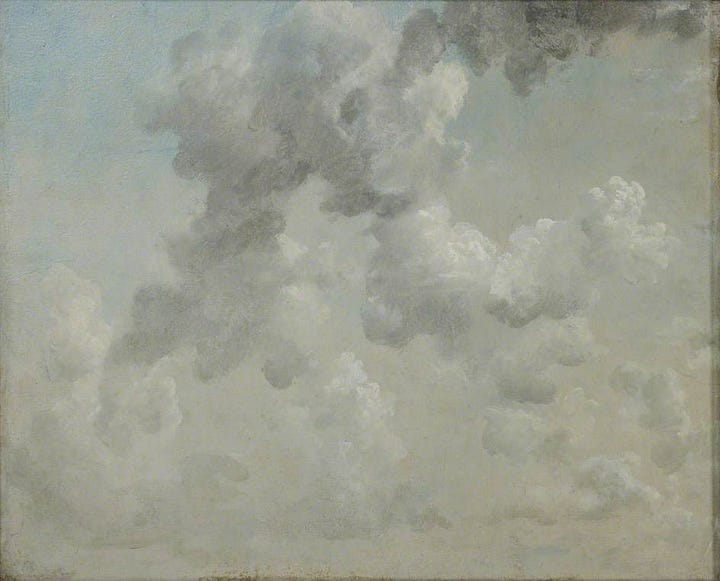
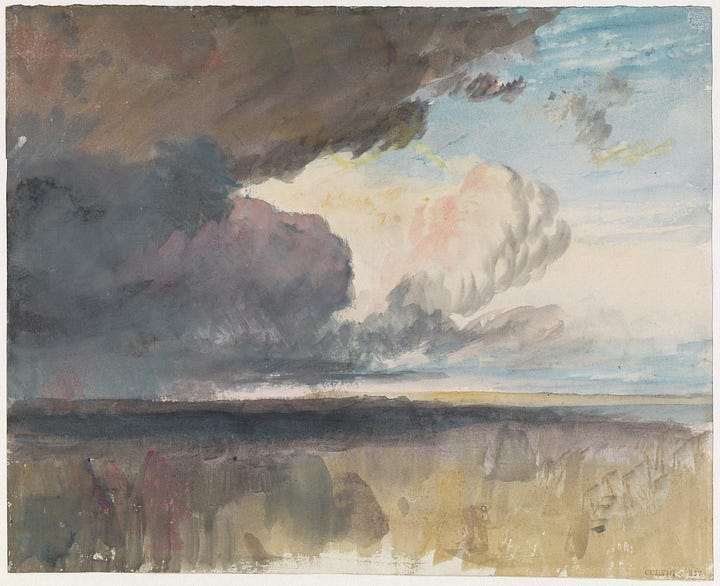
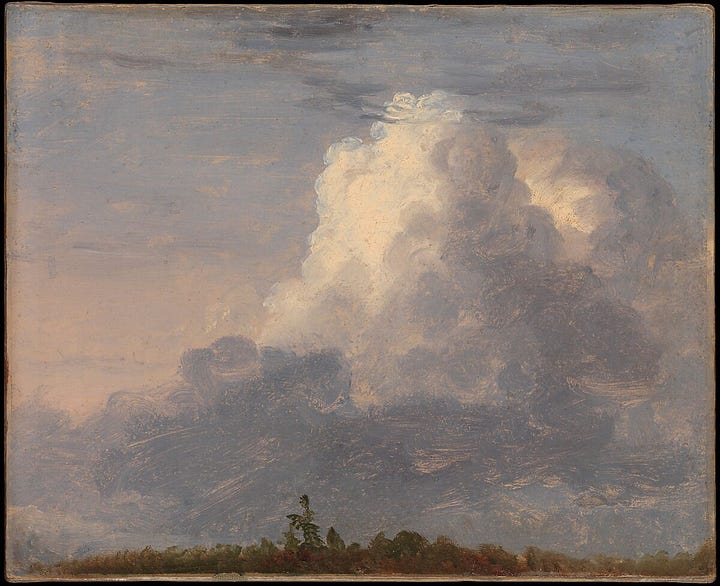
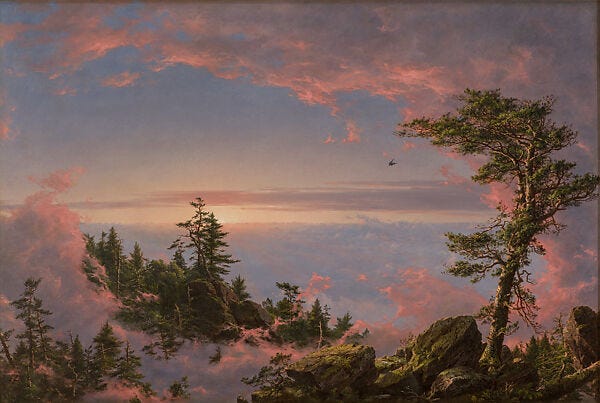
John Constable, Study of Clouds, 1822; J. M. W. Turner, Rain Clouds Approaching Over a Landscape, ca. 1822-40; Thomas Cole, Clouds, ca. 1838; Frederic Edwin Church, Above the Clouds at Sunrise, 1849


Mood Board of the Week
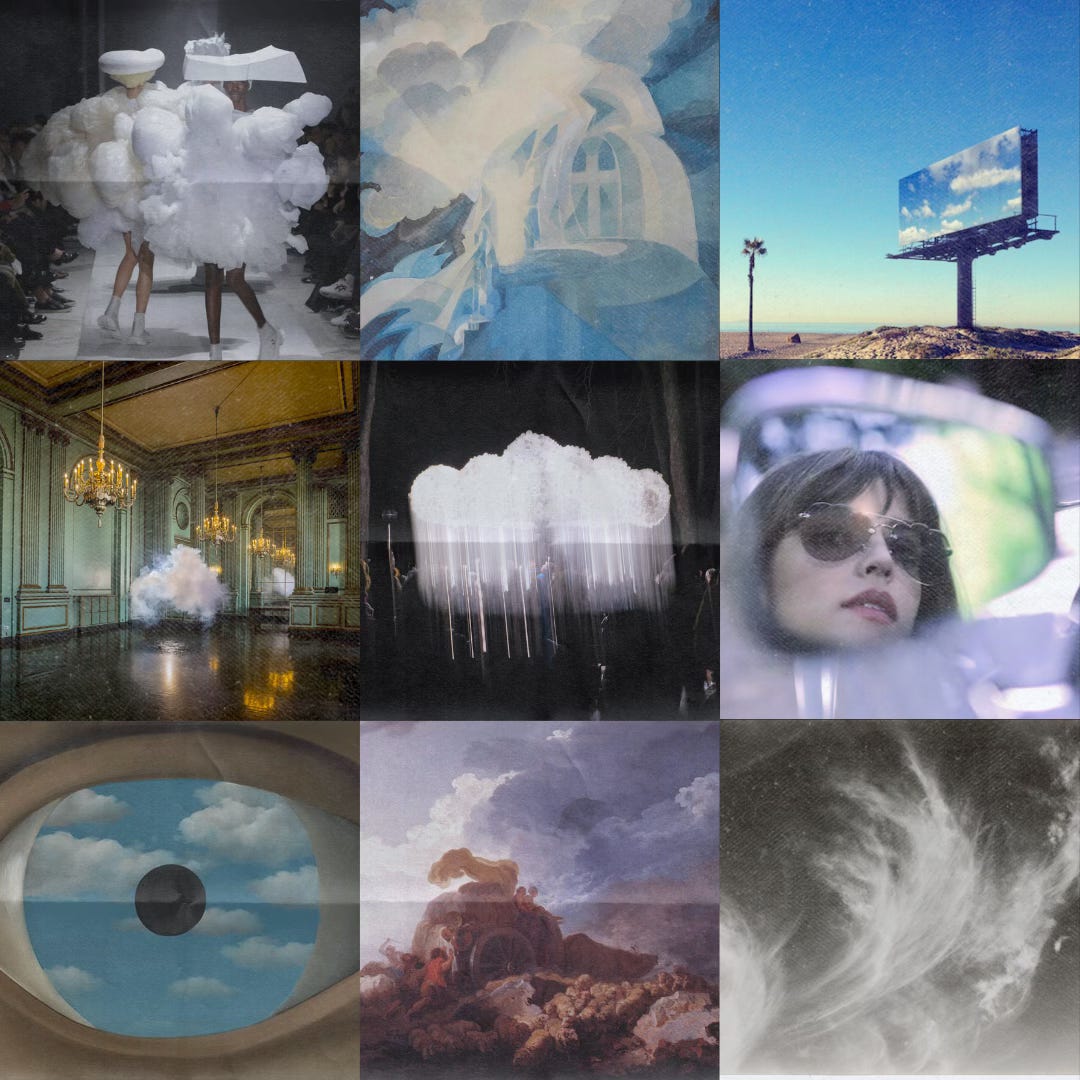
Comme des Garçons Spring 2025 Ready-to-Wear: Designer Rei Kawakubo titled Comme des Garçons’ Spring 2025 collection “Uncertain Future,” which might explain why all the eccentric silhouettes in this show wrap, swaddle, pad, cushion, and encloud the fragile human bodies beneath, erecting a barrier between wearer and viewer. The last three looks of the show turn their models into walking clouds and suggest that the uncertainty of the future is environmental in nature: look closely, and some of the puffs of fabric look like globs of plastic. In our uncertain future, will we be repurposing the little, very much not ephemeral clouds that are plastic bags into everyday garb?



Comme des Garçons, Spring 2025 Gaganendranath Tagore, Resurrection (1920): A nephew of Bengali poet Rabindranath Tagore, Gaganendranath Tagore, along with his brother Abanindranath, founded the Indian Society of Oriental Art. He incorporated techniques from Japanese painting and influences from Cubism into his work, both of which can be seen here—the former in the lightness and delicacy of the brushwork, the latter in the geometric shaping of the cloud-forms. Out of these clouds, accompanied by a burst of rays, a sort of door or window emerges: a portal to another world.
Benjamin Løzninger, C/Loud Project (ca. 2015): Why not bring the heavens down to earth? That’s exactly what Benjamin Løzninger does in this street art project, plastering buildings and walls with large-scale prints of clouds and cerulean sky. Forget all those boring people who tell you to be practical and realistic. Sometimes it’s good to have your head in the clouds.
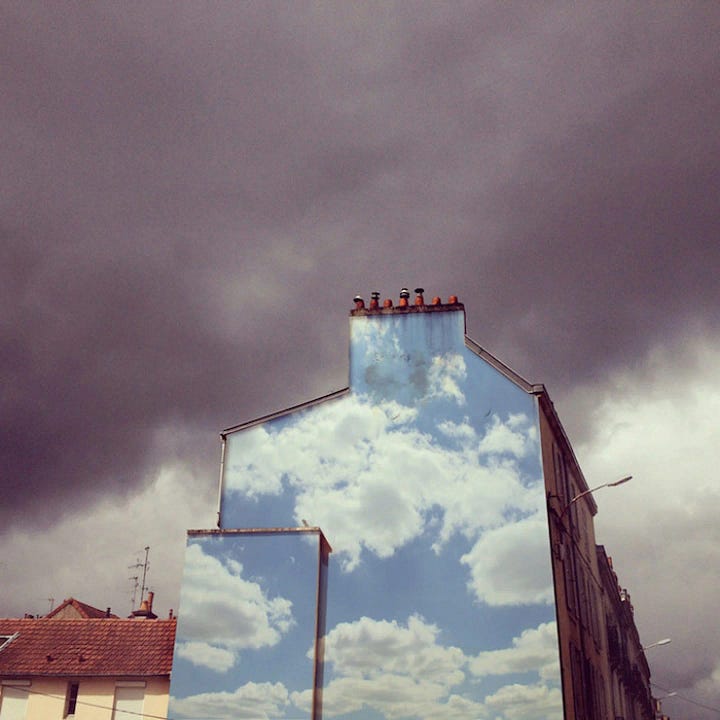
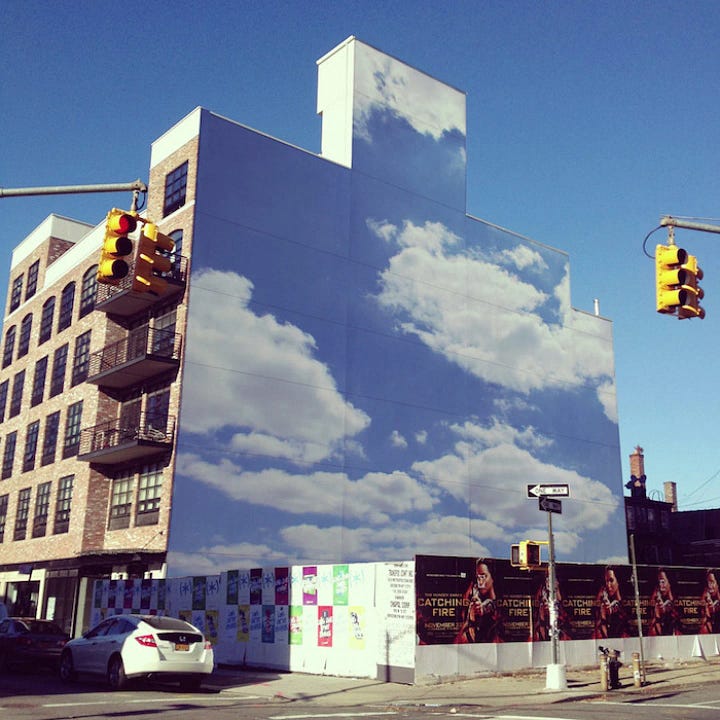
Benjamin Løzninger, from C/Loud Project Berndnaut Smilde, Nimbus Green Room (2013): Dutch artist Berndnaut Smilde’s Nimbus series brings the atmosphere indoors, crafting clouds in art galleries, industrial warehouses, and other unlikely locations. These puffballs of smoke and water linger for a few seconds—long enough to be photographed—then dissipate, dissolve, etherealize into nothing. Depending on its environment, such a cloud, Smilde says, could be “an element escaped from a landscape painting, a thought, a heavenly place, a concealing element, or simply an in-between state.”
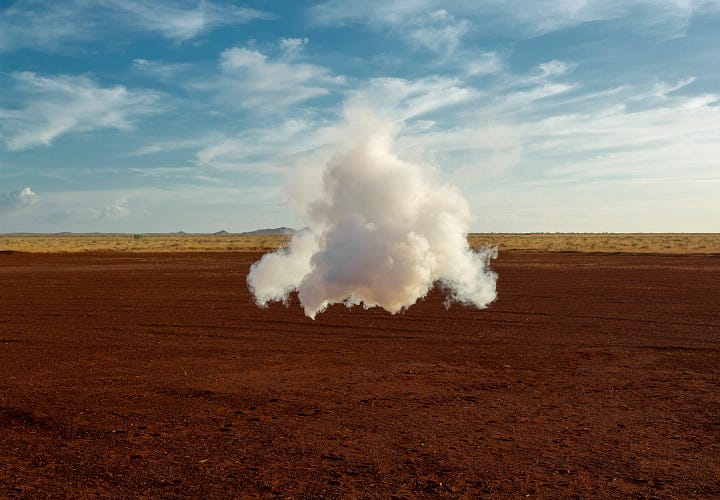

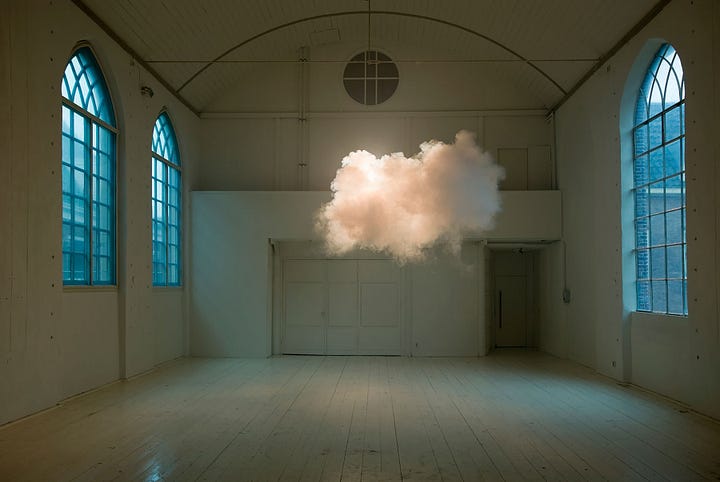
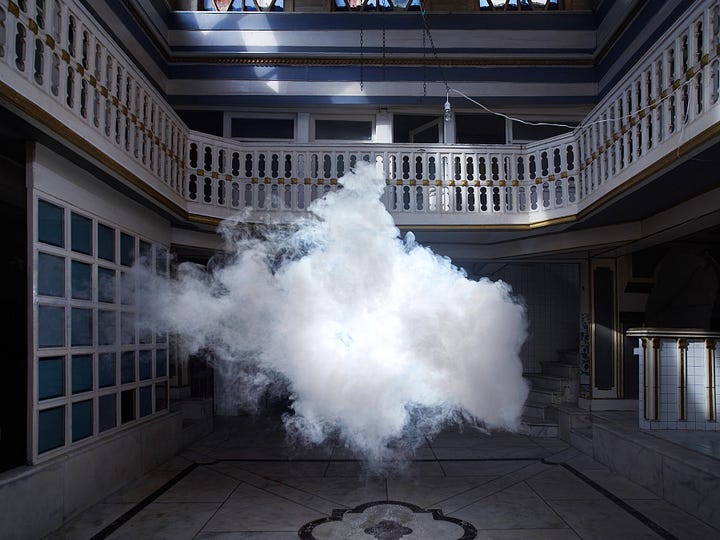
from Smilde's Nimbus series Caitlin r.c. Brown & Wayne Garrett, CLOUD (2012): I love it when art engages in a kind of trompe le doigt, if you will—hard materials made to look soft, like Bernini turning cold, hard marble into warm, malleable flesh. CLOUD may look soft and lamblike at a distance, but it’s actually glass and filament, an accumulation of 6,000 incandescent light bulbs. The “rain” that streams from the cloud is deceptive, too: it’s actually a curtain of chains viewers can stand beneath and pull, turning lightbulbs on and off. As incandescent lightbulbs are phased out in exchange for LED bulbs, the Protean nature of the cloud takes on the resonance of shifting technologies.
Miu Miu Cloud sunglasses: Sunglasses trends seem, cloudlike, to change often, and strangely, shapeshifting as the weathervane of fashion spins now this way, now that. Heart-shaped, round, large, narrow and skinny, square, barely there. Miu Miu, in 2019, came out with cloud-shaped sunglasses, in blue and pink tints, suggestive of “the female gaze” and “daydreaming.” The short promo film, “Head in the Clouds,” tells a tale of two lookalike girls. One loses her sunglasses; the other puts them on and sees the world through new eyes.
René Magritte, The False Mirror (1929): In true Surrealist style, Magritte’s enormous painting of an eye replaces the iris with a cloudscape: soft white fluff scudding across pure blue, interrupted only by the void of a flat black pupil. The realistic anatomy of this lashless eye serves to unsettle us further, while the flatness of the cloudscape suggests that we are not looking at a reflection in the eye—what the eye is seeing—but rather looking through the eye, its mirror transformed into window. Looking out at the viewer, this eye with its heavenly expanse suggests the All-Seeing Eye of God; indeed, fellow Surrealist Man Ray, who owned the painting from 1933 to 1936, felt the eye “sees as much as it itself is seen.” When we look into the eyes of another, we should be wary of making it a “false mirror” of our own selves. Instead, we need to look through, seeking to see the other’s inner landscape. For the eye is the window to the soul, and who knows but that the soul is a mass of ever-shifting cloud?
Jean-Honoré Fragonard, The Storm (ca. 1759): Fragonard’s The Storm embraces the dark side of the cloud, depicting an overcast sky that hangs ominously above a wagon stuck in the mud. Men try to push the wagon, sheep huddle, and a fabric covering whips in the wind, echoing the shape of the dark clouds around it.
Alfred Stieglitz, Equivalent (1930): In the 1920s and early 1930s, photographer Alfred Stieglitz focused his camera—and 40 years of photography knowledge—on clouds, producing a sequence of experiments he first called Music, then Equivalents. “Through clouds,” said Stieglitz, “[I wanted] to put down my philosophy of life—to show that my photographs were not due to subject matter—not to special trees, or faces, or interiors, to special privileges, clouds were there for everyone—no tax as yet on them—free.” Over the years, the photographs freed themselves of the grounding of mountains or trees or other earthbound objects, as though Stieglitz was attempting to pioneer a sort of abstract photography, images that, like music, served as equivalents to pure emotional states, echoing Romantic tradition. Stieglitz’s wife, painter Georgia O’Keeffe, shared his interest in clouds, producing a series of cloudscapes, Sky Above Clouds, from 1960-77.
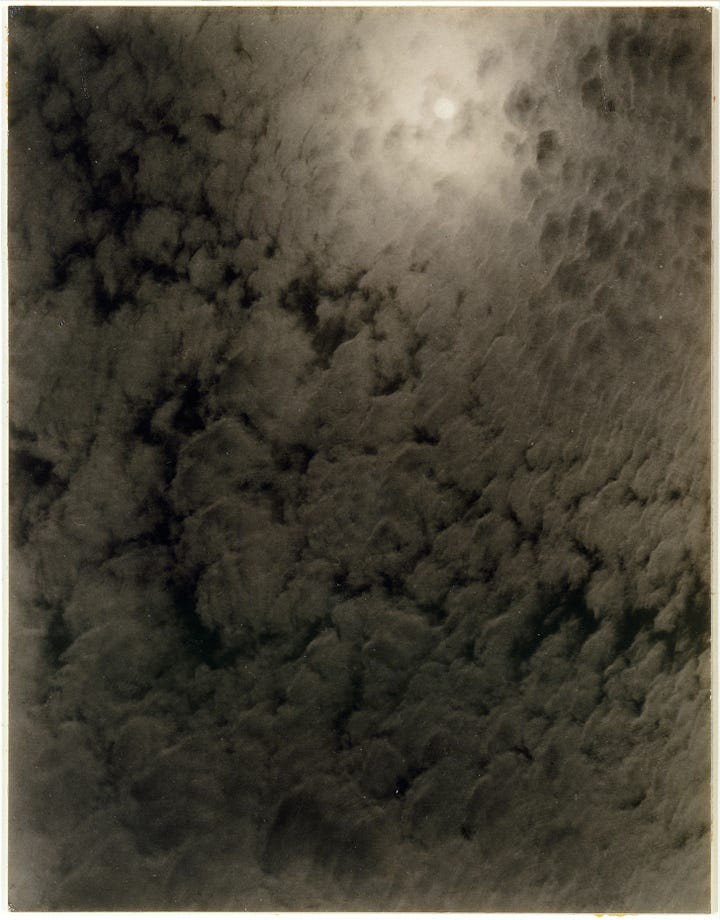
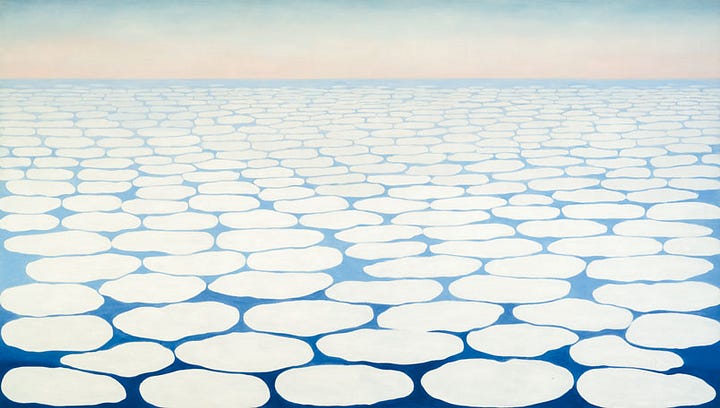
Alfred Stieglitz, Equivalent, 1926; Georgia O'Keeffe, Sky above Clouds IV, 1965


3 Things I’m In Love With This Week
Bride and Prejudice (2004): For more faithful adaptations of Jane Austen’s perennial favorite, Pride and Prejudice, I doubt anything will come close to the precisely realized joys of the 1995 BBC miniseries (how wonderfully grumpy Colin Firth is! how sharp and lively and smiling-lipped Jennifer Ehle is!) or the cinematic splendor of Joe Wright’s 2004 film (the proposal in the rain! the hand flex!), but my withering review of Emerald Fennell’s Wuthering Heights last week prompted me to think about literary adaptations that take creative liberties with or attempt to modernize their source material and succeed: Clueless, Baz Luhrman’s Romeo + Juliet, even a vlog version of Jane Eyre I enjoyed as a teenager. But a special place in my heart is reserved for Gurinder Chadha’s Bride and Prejudice, an East-meets-West Bollywood take on Austen’s novel. The Bennet family is reimagined in 21st century India as the Bakshi family, who encounter wealthy American Will Darcy at a wedding he attends with his British-Indian friend Balraj (Bingley) and Balraj’s sister Kiran (Caroline). Darcy eventually sheds his snobby, racially-tinged condescension to fall in love with Lalita, played by a radiant Aishwarya Rai.

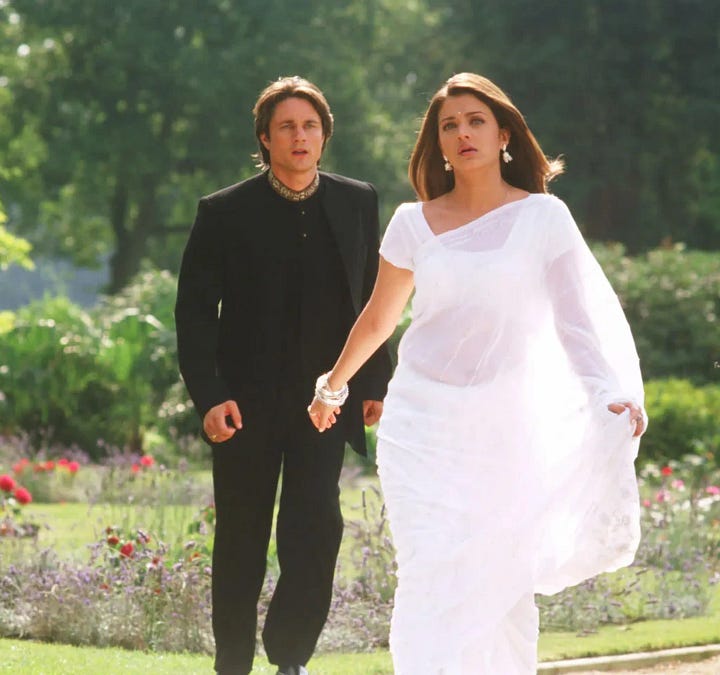

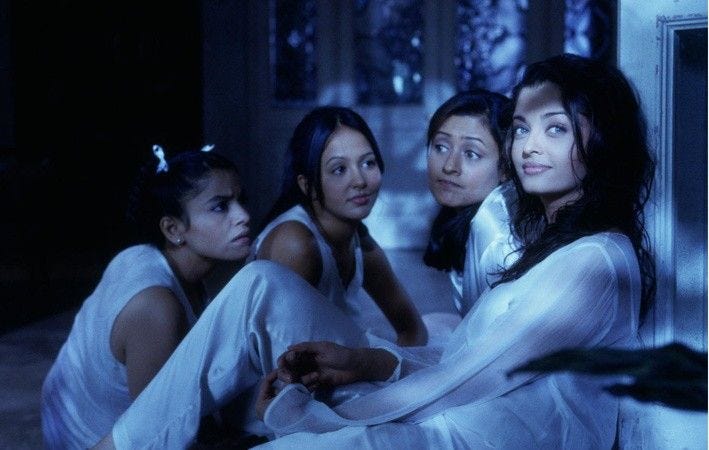
Like Fennell’s film, Chadha’s changes the race of several characters. Like Fennell’s film, it’s campy and over-the-top. Like Fennell’s film, it’s not afraid of color. But unlike Fennell’s film, it understands and loves its source material, as well as the on-screen world it’s trying to create. Wedding dances and garbas effectively, cheerfully substitute for Regency balls, and issues of diaspora and post-colonial culture clash meld with the original’s themes of class and wealth. The result is the rare movie that makes me unmixedly, exuberantly, wholly happy.
Dubliners by James Joyce: Reading Richard Ellmann’s biography of Joyce, I got the urge to reread Dubliners, which I hadn’t read all the way through since high school, though I’ve often revisited specific stories, especially “The Dead.” Any writer who is interested in writing short stories should read Dubliners, which, amazingly, Joyce wrote mainly in his early 20s. The common thread of the stories, aside from Dublin, is a sense of paralysis: characters are often stuck, mired, indecisive and ineffective. Speaking of clouds, one of the stories is “A Little Cloud,” where the protagonist’s unfulfilled ambitions as a poet and feelings of dissatisfaction are thrown into relief by a visit from an old friend who has since become a successful writer. Joyce’s ability to get inside of his characters, to both expose their flaws and follies and yet make us empathize with them, is masterly. It seems that I’m not the only one who’s been reading Dubliners recently: Celine Nguyen very accurately describes Joyce’s language as “unobtrusively beautiful,” Luke Savage calls his economy “astonishing,” and I just saw that Karthik Tadepalli is starting a Bay Area book club for it.
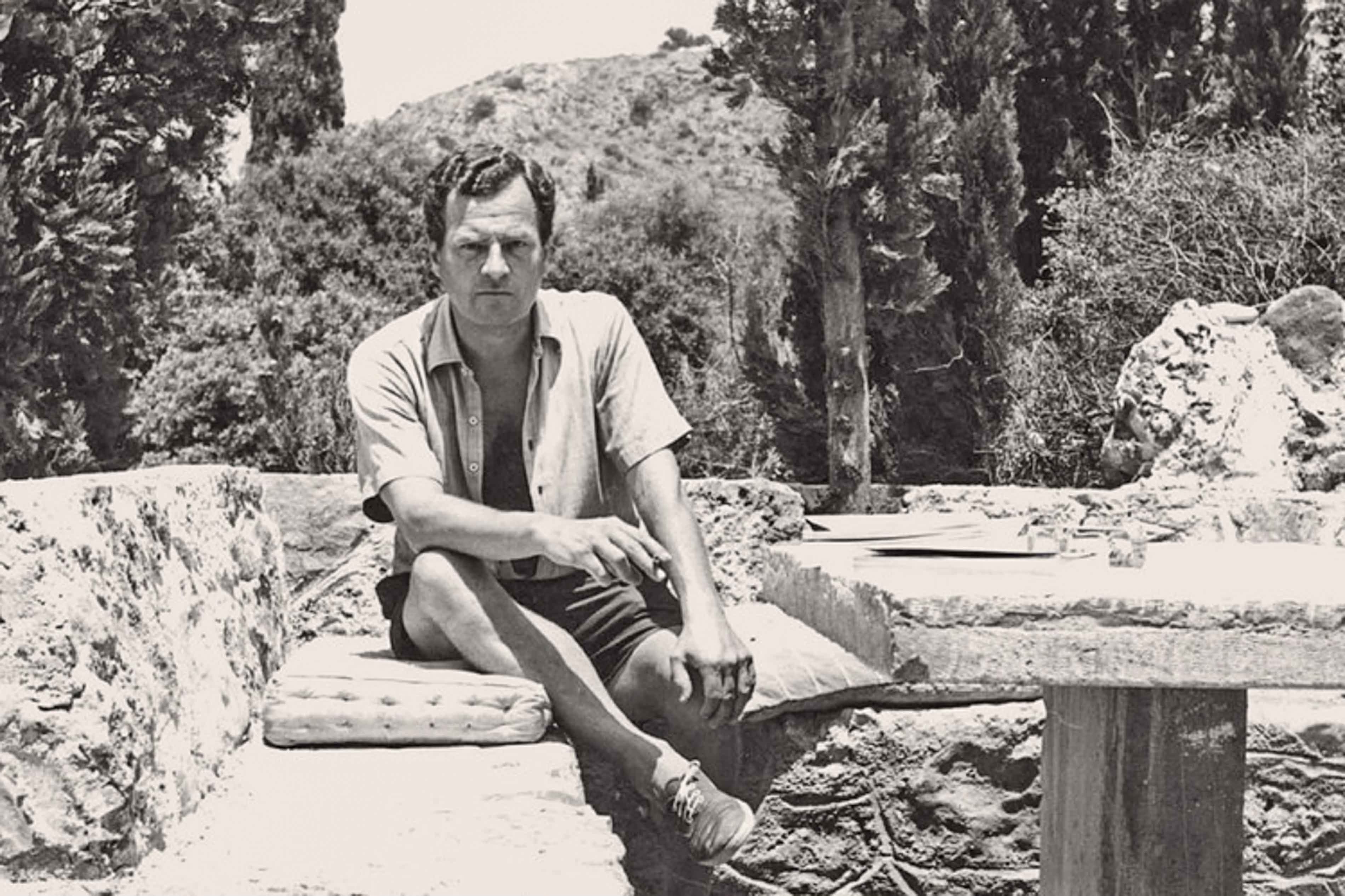
A Time of Gifts by Patrick Leigh Fermor: Will Diana mentioned this book in response to a Note I’d posted, and as I love walking and any book that appeals to the wanderer, the flâneur, the inveterate stroller within me, I began reading and was not disappointed. In 1933, British travel writer and soldier Patrick Leigh Fermor set off at the age of 18 for Holland, planning to walk across Europe all the way to Constantinople. Many years later, he wove together his diaries and recollections into A Time of Gifts. Travel writing is underrated nowadays. The Best American Travel Writing was slaughtered on the altar of The Best American Food Writing, with editors assuming travel blogs and vlogs could replace real, solid, well-crafted travel writing. They only need to read Fermor’s book to see how wrong they were. The quality of sheer likability that allowed Fermor to get food and shelter on his journey is equally lavished on the reader.


Words of Wisdom
“Rest is not idleness, and to lie sometimes on the grass under the trees on a summer’s day, listening to the murmur of water, or watching the clouds float across the blue sky, is by no means waste of time.”
— John Lubbock, “Recreation” (from The Use of Life, 1894)
Poetry Corner
“Clouds”
White sheep, white sheep,
On a blue hill,
When the wind stops,
You all stand still.
When the wind blows,
You walk away slow.
White sheep, white sheep,
Where do you go?
—Christina Rossetti
Beauty Tip
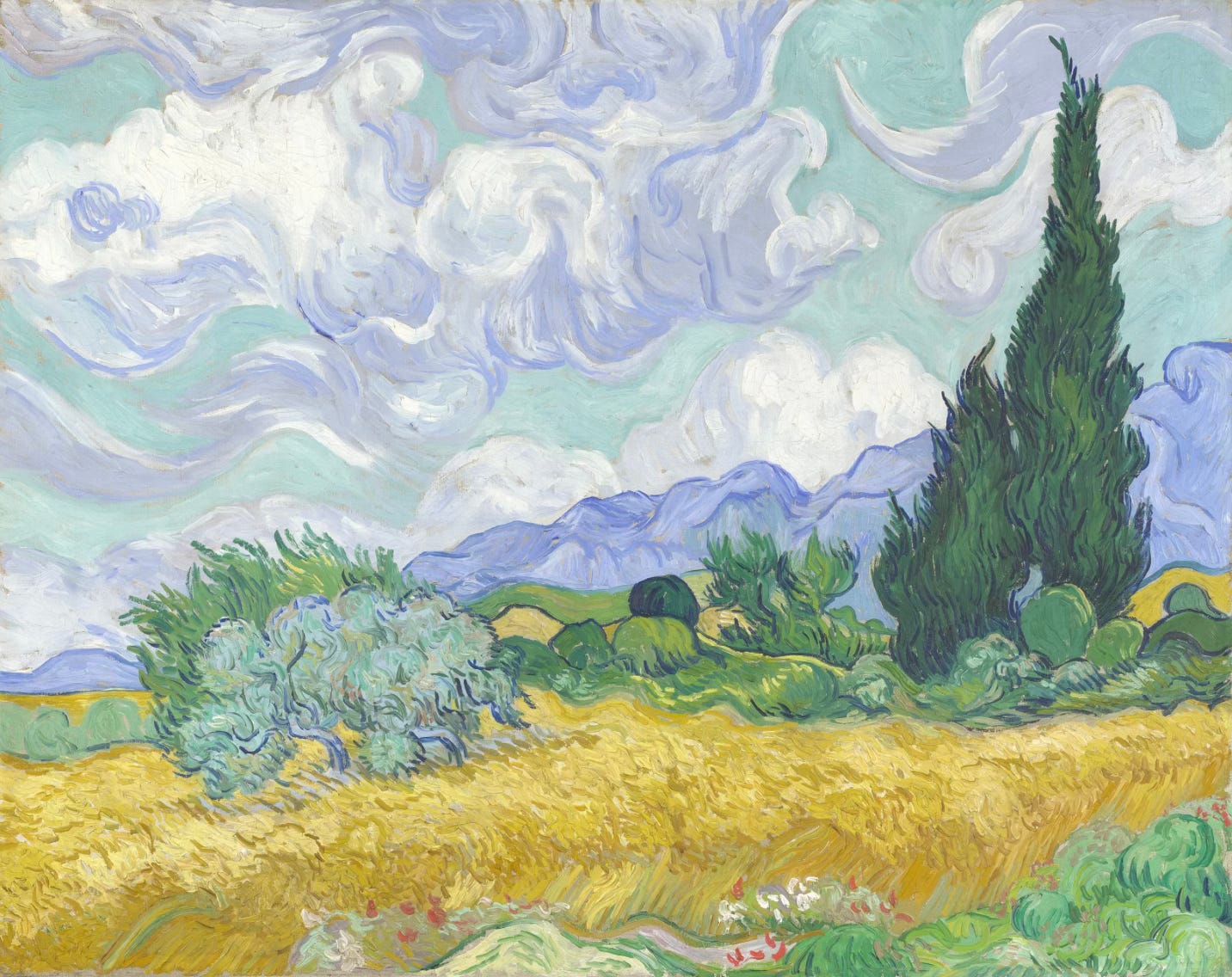
Cloudgaze! Use a swath of grassy turf for your pillow, the air for your blanket, and turn the sky into your cinema screen. Better yet if you invite a friend to swap visions and interpretations.
Lingering Question
What stresses in your life right now are just passing clouds?

Dear Readers, I haven’t done a post in this format in such a long time—I hope you enjoyed this one! If you did, please give this post a like and share with a friend, and as always, I’d love to hear your thoughts—on clouds, Dubliners, adaptations of classic books, or anything else—in the comments!
Excellent article, Nicely done. Pleasure reading it. Keep up the good work.
“Every Friday, you’ll get a little micro-essay”
Haven’t seen one of these FF’s in quite some time, Ramya. Really enjoyed your meditation on clouds today!