

Summertime Strangeness
and a suspicion of sun

I have written about spring and written about winter and written about fall; I have written about thunderstorms in the summer, I have written about trips I’ve taken in the summer, I have written about the sorts of identities women can take on in the summer, but I have not yet written about summer in general, treated it with the same consideration, the same reflection, the same meditation as the other three months. This is because summer itself does not invite consideration, reflection, meditation. Like a cloudless sky, it is a blank. Its serene, sunny surface is impenetrable. It lulls you like Bess the orphaned baby, crooning to you of the jumpin’ fish and the high cotton and how nothing can harm you. It does not want you to read too much into it. It does not want you to pry too closely. It does not want you to sit around. It wants you to be active, to go out and do things, to swim, to put your toes in the sand, to marvel at the brightness of rhododendrons in sunshine, to listen to birdsong, to open the windows, to sing a little song, and not think too much about any of it. Writing about summer is like writing about happiness. It is not meant to be dissected and probed and picked apart. It is meant to be lived.
Autumn provoked in Keats that marvelous ode to it, perfect in idea and execution, that speaks as though from the very soul of lyric. One could equally imagine a Keatsian “To Winter” or “To Spring.” These are seasons that change and progress and shift (autumn and spring), or if they are static (winter), they produce those graver emotions that bloom in solitude and ripen in thought. Perhaps what is needed is the cold, even a tinge of cold, cold itself or movement towards cold or movement away from cold. The closest approximation of a “To Summer” is Milton’s “L’Allegro,” and even that needed the companionship of “Il Penseroso,” even that begins with “loathed Melancholy” and “blackest Midnight” and “brooding Darkness” and “sights unholy.”
Summer vacation was something I always looked forward to in school, especially when I was no longer required to go to camp and mingle awkwardly with the other children and swim in a dirty pond and come home with my backpack and clothes full of sand. Home alone, I would lie on my bed naked after a shower with the shades shut, happy to have a human body, happy to be alive, happy to be young. I liked to trick myself into thinking that this lazy hazy daze would last forever, I could make it last forever. After all, the long days of summer, stretching one into another with nothing to do in them but walk barefoot across golden wooden floors or beneath shady canopies of trees, destroyed one’s sense of time. If I am here now, if I am present in this moment, I would think, I can stay here eternally, nobody can make me leave. I would lie by the French doors in the afternoon, in a patch of sunlight, and gaze up at the thick green boughs foaming and frothing and dancing and shimmering, a play of leaf and light and wind, listening to Arvo Pärt’s Tabula Rasa, and feel myself at one with an inexpressible immensity. Perhaps God was just wind through trees.
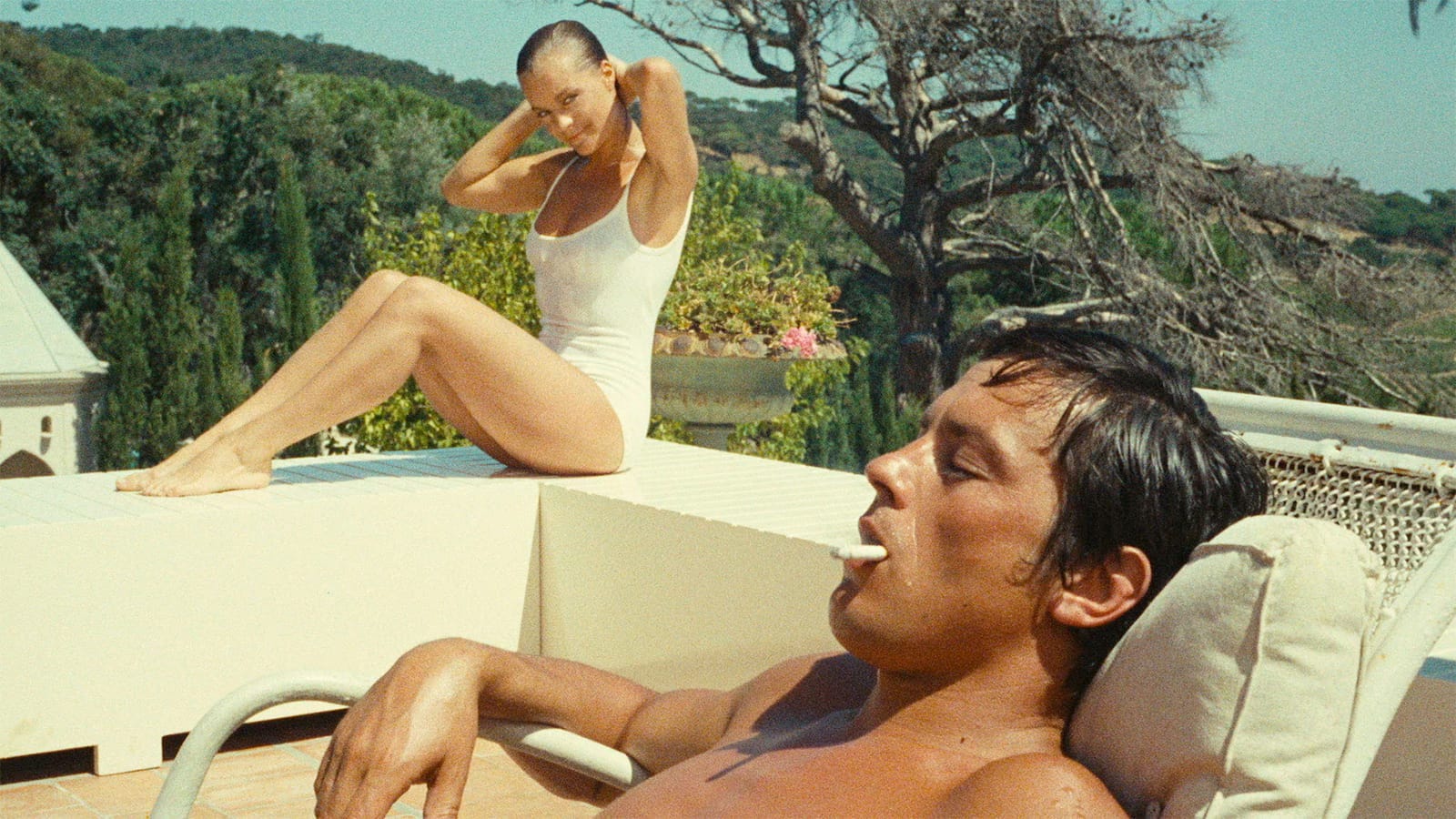
A few weeks ago, wanting to get in the mood for the official start of summer, I put on La Piscine. I couldn’t remember anything about the plot of the movie; only images stuck with me, flashes and glimpses like sunlight off of water, a chlorine-scented dream. La Piscine is about attractive Europeans with nothing to do but cheat on each other. Based on what I have gathered from le cinéma, attractive Europeans often have nothing to do but cheat on each other. Here it happens in the South of France, at a friend’s villa. There are four main characters, played by Alain Delon, Romy Schneider, Jane Birkin, and Maurice Ronet. Alain Delon is hot. Romy Schneider is hot. Jane Birkin is hot. Maurice Ronet is… not my type. At any rate, Alain Delon and Romy Schneider are boyfriend and girlfriend, as they once were in real life. Tan and sweaty and piercing-eyed, sexy and self-assured in the way that people ripening into their 30s are, they smolder from swimsuit to swimsuit, make eyes at each other, splash in and out of the pool, kiss, rub chlorinated bodies up against each other, play games of predator and prey. Maurice Ronet and Jane Birkin are father and daughter. Maurice Ronet is Romy Schneider’s former lover, whom she flirts with openly in front of Alain Delon. Jane Birkin is Alain Delon’s way of getting revenge on Romy Schneider and Maurice Ronet. It is all very Elective Affinities. Finally, late one night, a drunk Maurice Ronet falls into the swimming pool. Only Alain Delon is there to help. But instead of pulling his rival up, he pushes him down; comically, the head bobs up, the hand reaches out again, and again the head is pushed down, as in a game of whack-a-mole, down beneath the surface of the pool, which is where morning will discover the body dead. I was surprised to find that the movie had a plot at all. I had forgotten about the murder, the subsequent investigation that drags out the film’s ending.
When I began to think of other quintessentially summery movies, I realized that many of them were like this. Something is always lurking in the water, disturbing the serene, sunny surface. In Jaws a shark menaces a picturesque New England beach town, picking off unsuspecting tourists. Unfortunately this is not too far from reality: every time I visit the beach on the Cape, my fancies of splashing in the Atlantic are interrupted by giant red shark warning signs, complete with open-mawed, pointy-toothed pictures of said shark and the helpful caption that “people have been seriously injured and killed by white sharks along this coastline.” In Le Bonheur a happy family—happy husband, happy wife, two happy children, all of them going on happy summer picnics in the happy sunshiny woods—is threatened, destroyed, remade by the husband’s affair. The wife commits suicide, the mistress replaces the wife, and all returns to normal; the happy picnics in the happy woods resume, and the music of Mozart plays cheerily on. Yet summer is gone, and in the woods the trees are turning. In Nashville a summer concert is disturbed and innocence killed when a white-frocked, wide-eyed, beribboned country star is suddenly shot dead by a man in the crowd. I am reminded of Seamus Heaney’s “Blackberry-Picking,” where the pleasure of glossy August blackberries soon rots and sours: “…we found a fur, / A rat-grey fungus, glutting on our cache.”
It is hard to trust in summer, and it is hard to trust in happiness. When we are unhappy we are unhappy, and when we are happy we cannot allow ourselves to be entirely content. Surely a cloud will cover the sun, surely there is something lurking at the back of this our happiness, surely there is a body in the pool, a shark in the sea, a shooter in the crowd, a fungus on the blackberry, surely it cannot last.
I took a walk today, wanting to enjoy nature at the height of her beauty. The waters in the pond bent and flexed with a gentle breeze, reflecting the pure blue of the sky. Little robins hopped in the grass, and tiny red berries sprang up on bushes like full-mouthed kisses. Runners ran and walkers walked, and babies made funny faces in their prams, and dogs strained at their leashes, following their noses. It was afternoon and very hot, but the shade was cool, and every now and again the wind would bring a balm to the back of my neck. Everywhere the leaves were so full and so green, and an archway of boughs bent over my solitude, a natural cathedral.
Walking back home, I listened to music and was happy. A spring, or shall we say the summer, was in my step. In the front gardens were tall orange lilies like tropical maidens and oversaturated annuals and hydrangeas blue and deep purple and dark pink and white, not according to the acids in their soils, as scientists say, but really, it seemed, as the mood struck them. Soon I would be home and see my husband, and that, too, would be delightful. Crossing the street, I noticed what at first appeared to be a squirrel but was really a small, pale brown rabbit, lying on its side. Roadkill? Its one visible eye see was wide and vulnerable. Somehow suddenly it raised itself. It began to run, but it could only go around in circles. Clearly something was wrong with one of its feet; it inscribed the same circle over and over again, like a shopping cart with a faulty wheel, like an autumn leaf. Then it collapsed, lay down again in the inescapable heat, and did not move, and my heart skipped a beat, and the heat was so hot, and fear and horror and guilt and pity clutched me, and I hurried home, for I knew that the whole way back, through streets and past houses and among people and cars and bikes, I would find no shade.

Dear readers, I apologize for the long absence! I have felt my creativity coming back little by little lately, and I hope you’ve enjoyed this piece. If you did, please leave a like, share it with someone else who might enjoy it, and as always, I love hearing your thoughts and opinions in the comments! What are some of your favorite summer media? Do you love summer? Hate it? Fear it? Let me know!!
When I was little I felt the bliss of summertime too. The dark force was school in the fall waiting for me. I had lovely lazy days of reading, watching soaps and riding my bike. The kittens in the barn, playing princess it was wonderful. I liked your essay.
It's only here, I find myself wishing to read aloud. To taste the words.